The history of dubstep
Discover the history of dubstep, from its UK garage roots to its global explosion, with the artists and key moments of the genre.
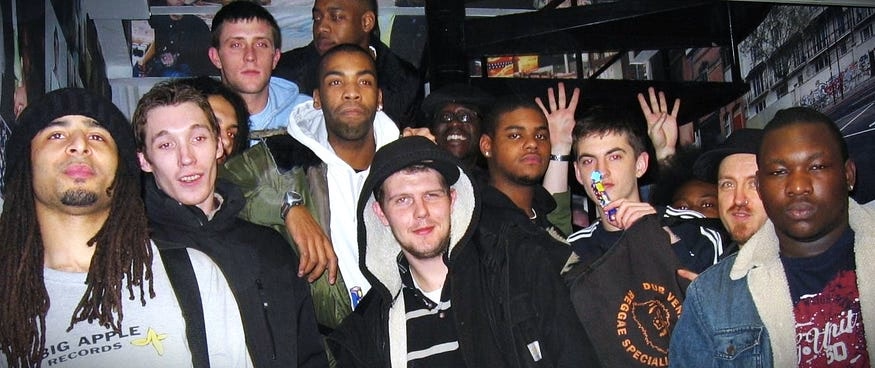
Table of contents
- 1- Genesis: an intrinsically English genre
- 2000–2004: new artists invest in radio, record shops, nights…
- Codification of the genre, and rise to power (2005–2007)
- Conquest of the New World
- Entry into the English charts and international recognition (2007–2012)
- Charts
- Sources
- Indicative bibliography
- Articles, posts
- Videos, documentaries
- 2 – The triumph of brostep
- Mass popularisation
- Integration within triumphant EDM
- Skrillex
- Proliferation of artists and diversification
- 2013-2015: the explosion of trap
- The reign of riddim (2013–today)
- References
- 3 – World Wide Wobble
- Beyond dominant genres
- Burial’s post-dubstep
- A genre inspired by urban environments
- How dubstep influenced music, notably EDM and Bass Music
- Beyond electronic music
- And pop in all this?
- Relationship between original “UK dubstep” and “brostep”: the “EDM” debate
- References
- 4 – Dubstep and technology
- Technology and its representation, cause of brostep’s transmedia role
- By bros for bros
- The vision of one’s own audience (on the internet)
- Technology as tool
- Wob knobs
- HOLY INTERNET
- EDM continuum
- References
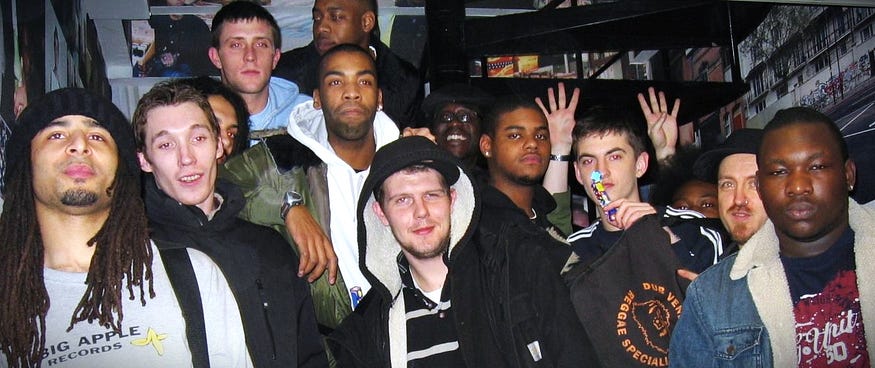
Dubstep Warz broadcast, 9–10 January 2006, BBC Radio 1
We are delighted to welcome Zacharie Gaborit to Dubstep Mag. Today, he presents a major, exhaustive feature tracing the history of dubstep. Zacharie has worked tirelessly to offer you a complete, detailed analysis of this musical genre, and we warmly thank him for sharing his expertise with us.
Zacharie Gaborit is a journalist. When he is not busy covering the news, he is passionate about the history of electronic music and web culture. We invite you to discover this fascinating work on Dubstep Mag. To find out more about Zacharie or get in touch, you can find him on LinkedIn.
If someone says dubstep… what do you think of first?
For some of those under 25, it evokes Skrillex, the year 2012, or video games. But for most people, it is something electronic, hyper-aggressive and saturated, that was fashionable at the start of the 2010s… which is actually a pretty good summary in the end.
In France, it reached the generation between millennials and Gen Z, now young adults.
From the beginning of that decade, some discovered this sound in clubs, especially around the capital, but many others discovered and lived dubstep through the internet: through playing an online video game, but above all through YouTube.
In fact, what reached those young ears at that moment was the culmination of a musical genre that is now in its twenties.
It had time to grow, to evolve, all while travelling the world. Let us set off to discover its history.
(Clarifications: These articles are the fruit of personal research; I make no claim to exhaustiveness. Furthermore, giving undue prominence to certain artists over others is difficult to assess when writing, even though the evolution of this kind of electronic scene happens collectively, and rarely through lone geniuses. If you want to cross-reference different histories of dubstep yourself, links to docs/videos/articles in English are available at the end of the article, after the “Sources” section. Right, I have finished covering myself — happy reading.)
Table of contents
1- Genesis: an intrinsically English genre
Great Britain occupies a particularly important place in the history of electronic music. When we talk about it, it is because it is there that dubstep emerged at the end of the last century, blending many influences: essentially dub, techno, breakbeat, jungle, and UK garage. We will take it slowly, no worries.
Dub, to begin with, is a movement born from Jamaican reggae consisting of instrumental tracks, with extensive remix work (notably the addition of sound effects).
Invented in the 1960s, it was renewed in the 1990s, with a new generation of musicians now using synthesizers and drum machines. Note that Jamaica, a former British colony, has a significant diaspora in England, especially in London.
At the beginning of the 1980s, house and techno appeared in clubs in Chicago, New York, and Detroit, in the United States.
But it was from the moment American acid house landed in British raves between 1988 and 1989 that a genuine electronic scene developed in the United Kingdom.
Techno and house (also called garage), centred on rhythm, with the kick drum on every beat, spread among the English. They very quickly offered their own versions of these musical genres, by nature dance musics.
Thus breakbeat appeared, using drum breaks from funk tracks (like the earliest hip-hop records), which opened the way to jungle in the mid-1990s: jungle reinforced the presence of breaks while speeding them up.
This dark genre set the tone for its heir, drum and bass, more repetitive, darker, and using basslines. In parallel, what is now labelled UK garage evolved as well.
“Speed garage”, close to its American counterpart through its regular rhythm (in 4/4), rubbed shoulders with “2-step garage”: even if both branches used breakbeat in England, 2-step is the one that most took into account its syncopated character, with 2 irregular kicks per bar (therefore not 4/4).
These English variations of garage, initially rather fast, slowed to 130 beats per minute with the decline in popularity of jungle. UK garage thus became the new fashionable electronic sound in England, mixing with other so-called “urban” musics, notably the vocal style of R&B. We are at the end of the 1990s.
But from 1999 onwards, the UK Garage scene began to go in circles a little. Producers like El-B, Zed Bias, and J Da Flex experimented at that time with more minimalist, darker tracks.
They imitated the atmosphere of drum and bass while leaving much more space. This sobriety imposed itself in reaction to the vocal side of garage at the time, considered too “pop”, not underground enough.
Vocal samples were replaced by basslines similar to those of speed garage, but deeper and repetitive: they brought a dub colour to the whole, all at 140 beats per minute.
Ghost – Bison “Bison” by Jay Da Flex. 3rd track on “The Club”, released in 2000 on El-B’s Ghost label
The birth of dubstep is very close.
2000–2004: new artists invest in radio, record shops, nights…
This stylistic renewal also includes English rap along the way, since with this new dark aesthetic “grime” develops, whose eminent representative is Dizzee Rascal (Orelsan’s British idol, who gave him a feature on “Zone” in 2017). This very London rap is the brother of future dubstep. It was in the year 2000 that Neil Jolliffe and Sarah ‘Soulja’ Lockhart (who has since become creative director at Sony Music UK) created Ammunition Promotions¹.
Through this company, the two would create several labels specialising in this fringe of dark garage set to develop.
We can cite Shelflife, Soulja, and above all Tempa, which would long remain the cult label of the birth of dubstep.
Ammunition would also organise the Forward (FWD>>) night from 2001 at the Velvet Rooms in Soho, then at the Plastic People club in London.
The DJs who ran the night often hosted a show on pirate radio Rinse FM, very important in spreading the English underground sound.
Among this small resident team at Forward, we find DJ Hatcha, who worked with Artwork at Big Apple Records, a record shop in Croydon, in south London. Big Apple would serve as a genuine meeting point for all “dark garage” devotees in south London.
#tbt Way before the days of Dubstep, Behind the jump at at The Legendary Big Apple Records HQ with shop owner John Kennedy, this would be us alllll day every day and ole uncle @artworkmagnetic would be up stairs in the studio mostly with @motoblanco creating History. pic.twitter.com/yMgLx3mGTF
— HATCHA (@DJHATCHA) July 26, 2018
In short, labels, a night, radio broadcasts, and a record shop formed an ideal network for the development of the genre.
All that remained was to find it a name: nobody really knows who the inventor was — between Kode9 and his “Dubsteppa Mix”, Neil Jolliffe speaking of dark garage being influenced by dub, or Hatcha at Big Apple… Be that as it may, in July, the 60th cover of San Francisco-based magazine XLR8R publicly launched the term “dubstep” on the occasion of an article on the trio Horsepower Productions.
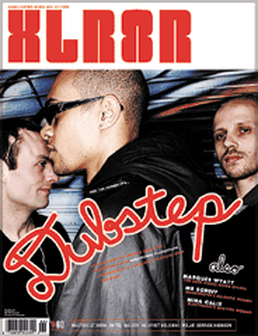
The only image available on the web of the famous magazine cover. (source: 12edit, “Dubstep” article)
“Shakleton was very uncomfortable with the term, but he inspired us. I do not really know what ‘dubstep’ is, in fact. It was just a feeling, a group of people, and a club — FWD>>. There were not many restrictions, just what we had to do to get there. I did not think about it much as a producer, but it clearly inspired me. In any case, many of the iconic producers of the genre appreciated that original spirit.”²
Appleblim (musician), 2008
The first floor of Big Apple, where the listening booths are located, would become a landmark for a few enthusiasts.
It is there that two producers who would help give the genre its credentials met: Benga and Skream.
It must be understood that at the time the two friends were barely over 16, and yet were fully part of the dubstep scene from 2003³.
The following year, two Big Apple regulars, Mala and Coki, formed the duo Digital Mystikz and launched their label DMZ. The crew that gradually formed, with Loefah and later Sgt Pokes, formed a “dub” wing of the scene, promoting their motto “meditate on bass weight”.
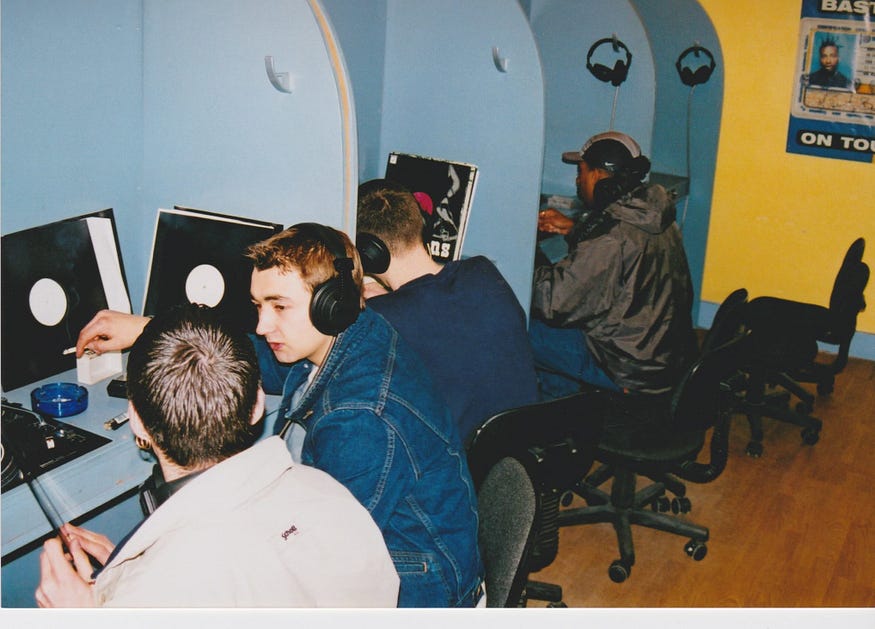
The “listening booth” on the 1st floor of Big Apple. (source: Big Apple Facebook, date unknown)
By late 2004, we can already cite many DJs specialising in this dark garage: first the pioneers — Zed Bias, Oris Jay, El-B, Steve Gurley, Benny Ill, J Da Flex, Wookie — then Hatcha, Youngsta (artistic director of Tempa), the group Horsepower Productions (which includes Benny Ill), Plastician, Artwork, Benga, Skream, and Kode9, founder of the Hyperdub label in 2004.
Some of these producers appear on the first compilation in the Dubstep All-Stars series created by Hatcha for Tempa.
DMZ, noticed by John Peel, the celebrated BBC DJ, released two compilations curiously named Grime and Grime 2 on Rephlex, Aphex Twin’s label.
Planet Mu, another IDM label, also began releasing dubstep titles that same year. Grime (“dirt” in English) was exploding at the time, more than its instrumental brother; this no doubt explains why at the time many people saw dubstep only as grime instrumentals.
In fact, the first half of the 2000s was still an era of sonic trial and error; dubstep encompassed everything at 140 bpm that focused only on the bass: thus many tracks willingly incorporated breakbeats, like the compositions of Vex’d or Toastyman.
Codification of the genre, and rise to power (2005–2007)
Back to Skream — his moment of glory arrives in 2005 with his track Midnight Request Line, a genuine dubstep anthem that would be included on the album “Skream!” released the following year on Tempa.
Skream – Midnight Request Line
Why is Skream cult? With Benga, the two are known for their minimalist style at the very least, but above all for having defined the dubstep sound.
It is around this time, among other things, that the majority of producers in the genre abandoned the highly syncopated rhythm signature of 2-step garage for something “simpler”, we might say — a kick/snare on the 1st and 3rd beats: what is called “half-time”, giving space in the tracks.
The release of the album would accelerate the popularisation of dubstep, which differentiated itself more and more from garage.
It was at the same time that journalist and DJ Martin Clark (alias Blackdown) began writing a monthly column “The month in grime/dubstep” in Pitchfork magazine.
This chronicler was one of the very first to take an interest in this dark garage wave, and documented it remarkably through his writings and interviews for seven years.
Still in 2005, Pinch, a DJ recognised for his genre blends, created Tectonic Records, on which numerous releases would bring dubstep and techno closer together, among other things⁴.
For their part, Mala and Coki linked their DMZ label to an eponymous night in March 2005. It rose very quickly in popularity; it was even forced to move to a larger room for its first anniversary in the face of an influx of 600 people.
Label, and now night, DMZ would notably count among its participants a certain Mary Anne Hobbs, who discovered dubstep there.
Mary Anne Hobbs is no ordinary figure: since 1997 she has hosted the Breezeblock show on BBC Radio 1, where she explores experimental electronic music.
Hobbs became passionate about dubstep, and became a kind of godmother of the genre on the night of 9 to 10 January 2006, organising Dubstep Warz, a special broadcast bringing together heavyweights like Mala, Loefah, Sgt Pokes, Skream, Kode9, Spaceape, Vex’d, Hatcha… in short, a lot of people.
Mary Anne Hobbs – Dubstep Warz [Skream, Mala, Kode9 + more] – BBC Radio 1 – 10.01.2006
This broadcast remains historic for dubstep fans today, because its influence was colossal.
To properly picture the British radio landscape, Radio 1 is the BBC network’s “youth” station.
It broadcasts contemporary music and benefits from varied shows taking advantage of the very dynamic musical scenes of London and the rest of the country.
It is therefore a huge megaphone that benefited dubstep in early 2006. Mary Anne Hobbs and Mala would DJ together at the Sonar festival in Barcelona in the following years.
Conquest of the New World
Even if the dubstep/brostep opposition is often linked to a UK/United States opposition, dubstep arrived in America well before the brostep wave.
Joe Nice is credited as the first DJ to have played dubstep and organised nights around the genre in the United States.
A native of Baltimore, it was at the Starscape Festival in his city that he first heard productions by Hatcha.
From then on, he would act as the first promoter of dubstep in the United States, chaining trips to England to immerse himself in the original underground scene.
Hatcha and the others began regularly touring the USA when Joe Nice and his friend Dave Q launched the first American dubstep night, Dub War, in New York in 2005.
The great success that followed pushed other DJs to organise their own nights dedicated to the genre.
“ There was Grime City in San Francisco, and nights in Chicago, Boston, Houston, LA, Seattle, and Portland. There quickly became a small milieu of DJs mixing only dubstep, cutting dubplates — we were there. ”
“ I do not want to claim to be “the guy at the origin”, but a lot of people saw that if it could be done in New York, they could probably do it too ”⁵ Joe Nice (DJ), 2012
From the summer of 2006⁶, the SMOG label promoted the genre and organised dubstep nights in Los Angeles.
It was in this small milieu that Flinch, 12th Planet, and a certain Sonny Moore would meet, all intrigued by this new British trend when he discovered the genre in 2008.
In Canada, 2006 is also the year Excision began his career as a DJ.
He would create Rottun Recordings in 2007 and make his first Shambhala Mix in 2008, but shh, we are already too far ahead in time!
Entry into the English charts and international recognition (2007–2012)
The Dubstep Warz broadcast arrived right at the moment when the genre finally managed to define itself and shed the “dark garage” label that stuck to it.
Because yes, overall, even the people taking part in the scene only truly began to become aware of their specificity between 2004 and 2006, at the moment when the genre codified itself musically.
Thus dubstep nights would flourish outside London, in Bristol, Leeds, Manchester, etc…⁷
2006 is also the era of a new generation of producers.
Caspa (creator of the dubstep and grime label Storming Productions, then Dub Police and Sub Soldiers in 2006 and 2007) would spot Rusko in 2007.
Almost two years after Dubstep Warz, the two DJs released their Fabric.live mix at the end of December 2007, generally considered the very first stone of “popular” dubstep.
This mix (incidentally made at the last minute after the cancellation of Justice’s) uses slightly less introverted tracks, more open, with wobbles more centred on mid frequencies.
The genre already seems cramped, while several artists are already labelled “post-dubstep”.
Rusko, for his part, would play with dubstep codes, exaggerating its specificities, like the presence of bass.
One of the inspirations for this rather humorous new sound is Coki, who would unveil innovative hits in 2007 like Spongebob, or the famous Night, featuring Benga.
Note the stronger presence of mid frequencies.
Beyond the particularly pushed dub and breakbeat side in Rusko, we notice the slightly shrill leads, like sirens, and the play with vocal samples.
This type of track, more “danceable” than introspective, would quickly pass from an episodic frequency to a genuine monopoly within so-called “dubstep” mixes.
It was also around this time that “purple dubstep”, or “wonky”, pushed by the grime scene, proposed a less dark version than initial dubstep, adopting funkier sonorities and sharing the bass with more pop synth sounds — a kind of alternative branch in the same approach as post-dubstep.
Developed since 2007, purple seems to have had its glory years between 2009 and 2011, notably with its undisputed representative Joker⁸, or Rustie and his eclectic album Glass Swords, very well received by critics.
An era in the form of a question mark, for a creative dubstep that was searching and moving in multiple directions.
“ The thing with dubstep, which makes it so interesting for any other scene, is you have percussion and bass, and it is like that all through the night, from start to finish, at the same tempo, with the same rhythm. With house, you have boom, boom, boom, boom. With dubstep, it is always the same speed, at 140 BPM, but it is everywhere. You have so many different producers doing half-step, hard-hitting stuff, a more tribal sound, more reggae, or techno. There are so many musical influences in dubstep. That is why it is such an interesting sonic universe. ”⁹ Hatcha (DJ producer), 2008
In hindsight, we can say that Caspa and Rusko’s Fabric.live acted as the trigger for a movement. In a way, the duo was no longer making dubstep; they were producing another kind of music, which would be revealed worldwide a few years later. And there normally you begin to feel brostep coming. We are there… soon. Not right this second.
Charts
Before Skrillex and company, the original form of dubstep eventually reached the top of the English charts and interested the global musical landscape at the end of the 2000s, like one of those new electronic genres that only the United Kingdom can produce.
Rusko would be among the English producers who, with Chase and Status notably, would for a time infuse pop music by collaborating with big names.
Since 2004, dubstep, in several forms, progressed slowly in the English charts, with a peak between 2008 and 2011.
Skream remixed La Roux’s song In For the Kill in 2009 and achieved great success in Europe.
The producer, with Benga and Artwork, released the Magnetic Man project in 2010, an album representing the culmination of UK dubstep mixed with pop music, notably with the voice of singer Katy B.
Several of their singles would be in the top 10 of the British charts. However, the number 1 spot would only be reached with the arrival of the first English “brostep” compositions.
Sources
— All links were verified on 18 September 2024 —
¹ “Ammunition Promotions Ltd.”, on Discogs.
² Carnes Richard, “Appleblim: Dubstep is a feeling”, on Resident Advisor, 18 July 2008.
³ “Artwork talks Dark Garage Music, Djing and Magnetic Man”, transcript on Red Bull Music Academy, 2011.
⁴ Citizen John, “2562: Dubstep in the area”, on Resident Advisor, 21 July 2008.
⁵ Dowling Marcus K., “INTERVIEW: JOE NICE and the HISTORY OF DUBSTEP IN AMERICA, PART TWO”, on The Couch Sessions, 17 January 2012, [personal translation].
⁶ “SMOG — 2 Years of Dubstep in Los Angeles”, on YouTube, 23 October 2008.
⁷ McFadyen Alex, “Croydon, community, soundsystem culture: Tracing the history of dubstep”, on Redbull, 12 June 2020.
⁸ Jones Charlie, “The Dummy guide to purple”, on Dummy, 28 June 2012.
⁹ Darkside, “Hatcha Interview”, on GetDarker, 23 July 2008, [personal translation].
Indicative bibliography
Articles, posts
Flatley Joseph L., “Beyond lies the wub: a history of dubstep”, on The Verge, 28 August 2012.
jinomusicuk, “Identity, aesthetics, culture and history about dubstep 1&2”, on dubstepforum.com, 30 October 2011.
Kek-W, “From the Archives: Dubstep Blows Up”, on Factmag [original publication: 2006].
McFadyen Alex, “Croydon, community, soundsystem culture: Tracing the history of dubstep”, on Redbull, 12 June 2020.
Palladev George, “Dubstep”, on 12edit.
Videos, documentaries
BearingUK, “5.3) That UK Sound – The Sound of Dubstep”, on YouTube, 21 July 2020, 1 hour 6 minutes.
Studio Rarekind, “Bassweight: A Dubstep Documentary – 2010”, on YouTube, 25 May 2017, 1 hour and 1 minute.
Timbah.On.Toast, “All My Homies Hate Skrillex | A story about what happened with dubstep.”, on YouTube, 28 January 2020, 53 minutes.
2 – The triumph of brostep
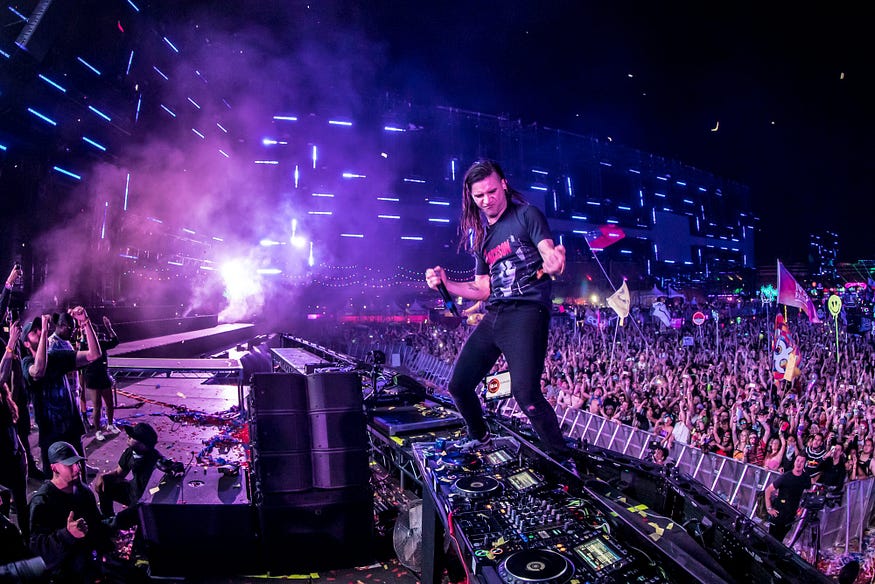
Skrillex on the Electric Daisy Carnival stage in Las Vegas, 2019
In the first part, we focused on the emergence of the genre in Croydon, in south London, on the ashes of UK garage at the beginning of the 2000s.
Over a decade, this particular form of garage — dark, introspective, blending dub bass and 2-step rhythm — revolutionised the English electronic scene.
We arrived around 2007–2008, a transitional period between dubstep and what would be called brostep, with sonorities less bass-focused and more aggressive, more electro.
Mass popularisation
For a few months now, between Rusko’s sonic experiments and the incursion of wobbles among pop stars like Britney Spears¹, dubstep has truly entered a whole new dynamic.
[HD] Bar9 – Shaolin Style (Nero remix) [Full]
Let us already make room for new faces: in England, drum’n’bass group Nero turned to dubstep, as did newcomers Bar 9, Cookie Monsta, Doctor P, Flux Pavilion, to name only the best known.
On the American side, we have Bassnectar, Excision, Datsik, and even electro house DJ Deadmau5, who tried dubstep in 2010 while acting as a springboard for Skrillex.
The Israeli Borgore would also contribute greatly to the popularisation of the brostep sound.
In 2009, the Never Say Die label was created by Skism and Mobscene.
In America, beyond pioneer label SMOG, numerous labels like those of Steve Aoki and Diplo — Dim Mak and Mad Decent — jumped on this over-caffeinated “dubstep”, ready for the party, benefiting from an underground reputation while already being quite far from original dubstep.
Concretely, how does the sound evolve?
The musical direction taken by Rusko and Caspa would hardly change: dubstep would begin to mix with many other styles of music. Here is a brief summary, by genre:
First, dubstep would adopt a few rock and industrial elements in the structure of tracks, notably the removal of syncopated elements towards a 4/4 rhythm.
We find a more direct sound, less introspective, better suited to mainstream dance tracks, in an era marked by bloghouse (for example groups like Justice or MGMT), and also by the rapprochement of dance music with pop.
Not far from rock, metal and dubstep at the very end of the 2000s are two particularly aggressive genres that, to a certain extent, play on repetitiveness. They share sonic recurrences: the centrality of rhythm, a powerful sound, and very heavy riffs, looped. Borgore and Skrillex come from groups that can be encompassed within metal, moreover.
Korn’s singer would even claim during an interview to have “invented” dubstep², which would obviously make the community jump.
EXCISION – X Rated ft Messinian [OFFICIAL] The heavy riffs
Then, in a more electronic register, glitch sonorities naturally accompanied the beginnings of brostep: increasingly shrill sounds, whose interest sometimes lies solely in their very rapid repetition over a short time, inevitably brings an aesthetic close to computer bugs to dubstep: in this, brostep and glitch-hop of the 2010s meet in their similarity with noise music.
**“I grew up listening to a lot of Aphex Twin and different things on WARP records that are a bit less danceable but more challenging on a production front. I like to mix that glitch and fidget element with dance music. It feels urgent and in-the-moment because things are changing a bit more.”**³
Skrillex
Porter Robinson – Say My Name Porter Robinson’s electro house/glitch-hop/brostep era in 2010.
The evolution of dubstep towards brostep also happens by incorporating voice samples, sometimes repitched, chopped, interspersed with synth phrases evoking electro house, as well as the famous wobble basses.
These repeat by definition, but here the frequency of the LFOs increases and varies more often with a palette of sounds now more turned towards mid frequencies than sub-bass.
Finally, the standardisation of the “drop” structure multiplies the power of “dubstep” sequences.
The latter is not unrelated to the practice of remixing pop songs. To both recognise the original track and integrate increasingly extreme brostep, producers are led to structure the track in a fairly binary way.
Often, the original song is contained in the calm parts, as well as the build-up, and the drop constitutes the only genuine sonic element the remixer brings — either by doing something completely different, or by still integrating bits of phrase from the original chorus, reworked to have a glitch effect.
La Roux – ‘In For The Kill’ (Skrillex Remix) First remixed by Skream, “In For The Kill” was also remixed by Skrillex a few months later in 2010.
To summarise, dubstep assimilates over these few years multiple popular electronic sonorities: it joins the moving train of Electronic Dance Music.
Integration within triumphant EDM
The explosion of EDM at the end of the 2000s, which would propel dubstep, is explained notably by its incorporation into pop music: at the end of the 2000s, after the incursion of hip-hop rhythms into pop stars’ albums, their tracks truly evolved towards much more dance, electro sounds — a wave symbolised by the meteoric success of David Guetta and the Black Eyed Peas. “I Gotta Feeling” is sometimes considered the hit that made American radio realise it could now play electro tracks as well as rock hits.
It is therefore a conjunction of factors that meant popular electronic tracks at the end of the 2000s could temporarily integrate dubstep sonorities.
In those cases, it is often the most characteristic element — the wobble bass — that returns.
This “EDM-isation” of the genre also brought brostep closer to techno and dance, which at the turn of the 2010s also adopted a glitch side.
We can hear it in the BPM, which gradually accelerates in certain compositions, from 130, to 140, up to 170 bpm.
Not only is it more conducive to dance and EDM mixes, but second drops can also go into drum’n’bass: welcome to drumstep.
Moreover, the drum’n’bass scene (notably influenced by Pendulum’s aggressive but popified sound) effectively converged at the end of the 2000s towards a sound centred on saturated, very dynamic basses.
Thus DJs like Dirtyphonics, Bassnectar, or Nero would participate in both scenes.
While these three names would contribute through their style to a rapprochement with rock and heavy metal sonorities, neurofunk group Noisia would influence the scene in a more technical way⁴, through their very innovative sound design.
They would contribute greatly, for example, to the sound today considered THE brostep snare drum, which Skrillex drew inspiration from at the beginning of the 2010s: a sound that is at once punchy, round, and sometimes reverberated — a kind of boosted version of the TR-909 snare. Right, Skrillex, let us talk about him:
Skrillex
If we had to remember one name among those who popularised brostep worldwide, it would unquestionably remain Skrillex.
Sonny Moore by his real name — remember — discovered dubstep in L.A. in 2008.
Very quickly inspired by the genre, and taking advantage of his mastery of software FM synthesizers, Skrillex became within a few years a flag-bearer of the entire scene, with the help of his “mentor”, 12th Planet.
More than others, Skrillex found a formula blending the energy of rock with ultra-compressed synthetic sounds, giving the genre a level of popularity unthinkable a few years earlier.
That same year, Skrillex was spotted by deadmau5, who would have him participate in the production of his album 4×4=12, whose certain singles bathe in the influence of this “Americanised” dubstep.
Moreover, the Canadian had him sign an EP on his very recognised mau5trap label. It was just a few weeks from the deadline in October 2010 that Skrillex would compose some of the tracks on the EP.
Among them, he created a bomb: Scary Monsters and Nice Sprites.
At the time, he mainly wanted to make a little extra track to complete the record. But this improbable title with its bipolar structure would propel Skrillex both into festivals and onto YouTube.
Skrillex – Scary Monsters And Nice Sprites (Official Audio)
Between filtered and energetic melody, monster sounds created with FM synthesis and iconic snare drum, Scary Monsters instantly became a standard that defines the brostep sound in the world.
Indeed the single looked further than English or American underground milieus thanks to the internet, and would have considerable influence on a whole new generation of producers.
At the time, the track created surprise, and by consecrating its author, called into question both the barriers between musical genres and the way music is conceived and can be popularised (thanks YouTube, by the way).
The entire EP would also be a success, notably Rock n Roll, a sound more electro and glitchy than Scary Monsters.
If Skrillex remains one of the most influential dubstep DJs, it is because he became “Mr.” dubstep for both the public and musicians.
In 2011, he continued to collaborate, this time with nu-metal group Korn on their album The Path of Totality.
That same year he released a sequel to the Scary Monsters EP, then in December the Bangarang EP. The eponymous single is probably Skrillex’s most radio-played hit, at least in Europe.
The DJ’s meteoric breakthrough made him one of the first representatives of the very young EDM scene at the Grammy Awards from 2011.
That year, he won in one go the Grammy for best dance recording for Scary Monsters, best dance/electronic album for the eponymous EP, and best remixed recording, non-classical for his cover of Cinema by Benny Benassi.
Same again the following year with, in the same order, Bangarang, the entire EP, and the remix of Promises⁵.
Beyond brostep, Skrillex is in fact a very eclectic artist, having collaborated since with numerous headline names notably from the rap scene.
A rock singer producing avant-garde dance music while imprinting his sonic signature on big rappers.
Once again, Skrillex can be called “symbolic” in more ways than one.
Proliferation of artists and diversification
In short, between 2010 and 2012, after the brostep pioneers, between Nero’s sci-fi sound, Flux Pavilion’s shrill leads and Skrillex’s monstrous growls, a new wave of inspired artists launched into brostep, this time with a genuine connection to the rest of the very young EDM galaxy.
Among the best known, two members of drum’n’bass group Pendulum, Rob Swire and Gareth McGrillen, launched the Knife Party project in 2011.
The duo distils a unique blend influenced at once by the sound of their former group, brostep, and Swedish House Mafia, adding a touch of self-deprecation in a musical universe that sometimes takes itself too seriously.
While mau5trap released the first singles and albums for certain brostep artists, the first specialised labels like Never Say Die gained importance, with Skism, Zomboy, Dodge and Fuski, Eptic, Habstrakt, Laxx, Bare Noize, rock group Modestep bringing a very vocal style, or Figure, combining drumstep and horror film atmosphere.
In the lineage of Noisia, the duo Koan Sound would swing brostep by associating it with neurofunk.
The UKF Dubstep promotion YouTube channel greatly helped artists like Zeds Dead and Blue Foundation popularise their dubstep tracks worldwide. At OWSLA, Skrillex’s label, names like Kill the Noise and Barely Alive would quickly emerge.
Certain artists who can only be classified in the EDM label wave tried the genre, like Zedd, or Porter Robinson, while conversely self-proclaimed brostep producers attempted to bring a greater dose of globalised dance music.
This period, between 2011 and 2012, saw brostep assimilated by certain big EDM labels like Spinnin’ Records or Ultra Music, which tried to offer a more electro house, vocal version — more popular, in sum.
The vocal side, first attempted by Magnetic Man or DJ Fresh in another era, developed and persisted under the name melodic dubstep, with Seven Lions or Cosmic.
Seven Lions with Myon and Shane 54 – Strangers (Feat. Tove Lo)
Some will say that dubstep was “commercialised”.
In fact, it accompanied the massification of the public gathered around EDM.
The business, essentially centred on shows, developed very rapidly between 2010 and 2012. One of the characteristics of EDM is indeed that of music massively broadcast during big festivals.
Among the biggest EDM events, the 2011 edition of the Ultra Music Festival in Miami is the first to invite a whole series of dubstep producers, from Skream and Benga to Skrillex.
With more than 300 dates per year at the beginning of the 2010s, Skrillex is, fortunately for everyone, an exception in the world of electronic touring and concerts.
Nevertheless his lightning success boosted the popularity of numerous events in America and by echo in the rest of the world.
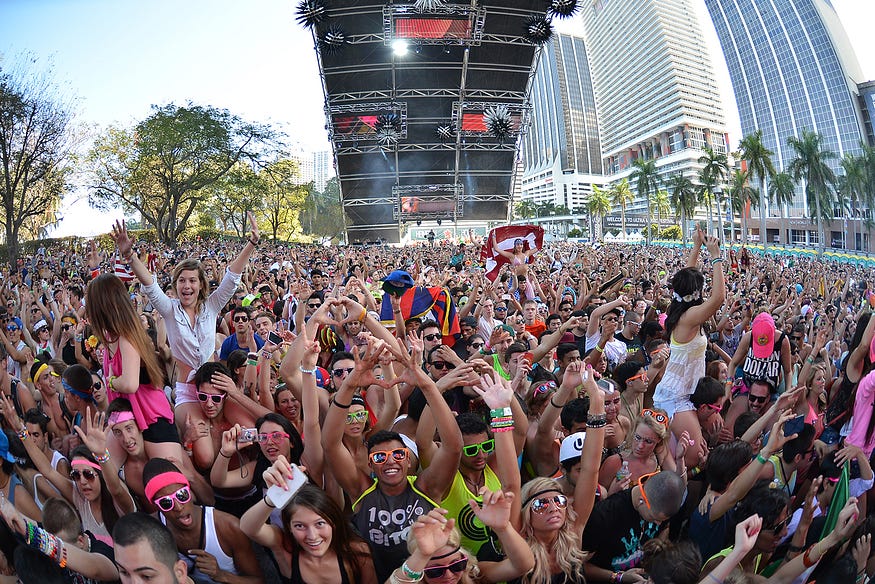
UMF in Miami, Electric Daisy Carnival in Las Vegas, Tomorrowland in Belgium — EDM even invaded more generalist festivals like Coachella or Lollapalooza⁶.
Moreover, if “I Gotta Feeling” rolled out the red carpet on radio, Daft Punk’s LED pyramid, unveiled at Coachella 2006, established standards in terms of sound-light synchronisation and shows on which all these electronic festivals are based.
2013-2015: the explosion of trap
We move forward a little — from 2013 onwards, another generation arrives, influenced by global EDM: among others MUST DIE!, Virtual Riot, Pegboard Nerds, while Dodge and Myro create their Disciple label and Downlink creates Uplink Audio.
At the same time, a new current arrives in EDM, brought straight from southern US rap by Diplo and his Mad Decent recruits: trap music.
In 2013, blow for blow, Harlem Shake and Turn Down for What changed the dance music landscape.
In fact, the genre would simply find itself alongside brostep in the bass music family of EDM, the two influencing each other and opening new paths.
Trap, characterised by the use of TR-808 drum sounds and a half-time tempo, adopts the drop principle, replacing choruses with voice samples coupled with repetitive synths; brostep, for its part, adopts the robotic rhythms of the TR-808, in particular the snare drum and cymbal patterns.
Moreover, EDM digested at the same time as trap music more Latin musical elements, with dancehall or reggaeton elements.
One of those responsible for this Latin contribution is none other than Diplo, with his Mad Decent label, as well as his group Major Lazer.
In short, trap would influence more and more producers, all the more so as it returns to a certain form of minimalism in the drops.
Zomboy – Nuclear (Hands Up)(release: 2013) | An example of brostep on moombahton rhythm (and at the 2nd drop drumstep at 3:40)
Even if trap is minimalist at base, brostep continues to maintain the objective of going to extremes, while the Serum synthesiser relaunched producers’ creativity.
The genre splits into a multitude of specific sounds.
Some musicians opt for a brighter sound, like Ghastly, Getter, Slushii, Snails, or MUST DIE!, with sharper snares and sound design leaning towards strident highs.
Overall, numerous producers go towards even “dirtier” sound design sometimes called filthy dubstep or “heavy” dubstep.
A noise-leaning tendency unofficially named deathstep, represented by Code: Pandorum, falls into a noise category very linked to horror film atmospheres (Figure is less extreme from that point of view), and uses sonorities from death metal.
And then there are the sci-fi aesthetics of Excision, Downlink, Space Laces, as well as the metallic sounds of Getter or Trollphace which give wobbles their due again, after an excess of Scary Monsters-style growls for a few years.
Moreover, these metallic sounds prefigure the advent of a regeneration of EDM-ised dubstep: the riddim wave.
“People still want that extreme sound but in a different way. They do not call it partying over here, they call it raging. Are you coming out to rage tonight? That is the culture that surrounds us here. The energy dictates how things move.”⁷
JVST SAY YES
The reign of riddim (2013–today)
Because indeed, from the mid-2010s onwards, a dubstep sub-genre gained a lot of ground: riddim.
The word itself comes from Jamaican patois, from the English word rhythm.
In the dubstep universe, it designates a rather particular tendency, founded on fairly repetitive basslines (often with the same sound throughout the drop), rhythm simplified to the maximum (a kick and a clap), and a relatively minimalist atmosphere.
It takes its roots in England around 2011, with artists like Jakes, Kromestar, Coffi, or Bukez Finezt, contrasting with brostep which was exploding in parallel.
From 2013 onwards, Subfiltronik and the rest of the Monsters crew gave the genre the little boost that would allow it to measure up to brostep.
Indeed, the flanger and trap rhythms generalised and transformed riddim into a sub-genre perfectly adapted to “EDM” mixes.
When, around 2015, riddim began to replace dominant brostep, the latter was confronted with a kind of return to sources.
“ It is the perfect combination of American and UK dubstep ”⁸ RUN DMT
Riddim, indeed, is described by its promoters as the return of original dubstep sound.
In parallel with the decline in popularity of brostep, it reconnects with the original interest of dubstep: energy comes from rhythm over the long term, and not from a constant set of shrill stimulations
Bommer x Crowell – Yasuo Included on SMOG compilation Battle Royale Vol. 1, released 7 October 2014
“Dubstep has that energy of being hard and tear-out and right in your face. Riddim gains its energy through much more of a flow and not just being crazy in your face stuff. It is a special flow that makes you want to move in a certain way.”⁹
INFEKT
The sub-genre brings a new playground, in a brostep struggling to reinvent itself without merging into global bass music.
Arriving in the USA through producers like Benzmixer, Airvalue, Allesnik, or Megalodon, riddim now dominates brostep DJ mixes so much that the practice of chopping (mixing two tracks quickly) has become commonplace, so aligned are the drops on the same rhythm.
Riddim gradually invites itself into all the big historic brostep labels: Trollphace collaborates with Skrillex on OWSLA, Battle Royale compilations follow one another on SMOG, Never Say Die creates the Black Label division in 2015, and the roster amassed by Disciple gradually integrates riddim into its brostep. Thus Virtual Riot notably enjoys a new surge of popularity, with his creative talents and polished sound design.
Riddim from Phiso, Infekt, Breton Samplifire or more generally from Disciple also brings a humorous side that contrasts with Black Label brostep, or Excision “taking itself seriously”.
With phrases or sounds from video games or Japanese anime, second-degree humour is omnipresent in a genre so brutal it would become ridiculous.
Get Heavy x Heavy Dub with ECTO
The Disciple: Roundtable division would also recruit a few UK Dubstep pioneers, such as Hatcha.
Riddim succeeds in this in uniting old school and new school through a genre as dynamic in EDM labels as in the underground. New school itself is also reformed, after a few years of trial and error and distancing.
“_Riddim is basically what happened when the American SoundCloud underground dubstep culture noticed what the U.K. guys have been doing since day one. To me, riddim is not a genre, it is an adjective specific to only dubstep songs — a dubstep song can be like 1–10 on the riddim scale.”¹⁰
SUBTRONICS
The future of riddim is now being drawn in the lands of bass music, seeming to go ever further into noise, strident samples, like the latest releases from Prime Audio, or sword fight or chainsaw sounds at Hekler, mixing with the freeform bass of Peekaboo or G-Rex — a kind of blend between trap and riddim.
That is where we are today in 2024 in mainstream dubstep.
But what becomes of UK dubstep today?
The “real” dubstep? Well, it lives, and rather well. But for that, see you next time.
References
— All links were verified on 9 September 2024 —
¹ “The Genre Fix: The History Of Dubstep (Hosted and Mixed by RUN DMT)”, Kill Your Ego, SoundCloud, 07/08/19. [at 7:40]
² Mason Kerri, “Korn’s Davis: ‘We Were Dubstep Before There Was Dubstep’”, Billboard, 28/11/11.
³ Florino Rick, “Interview: Skrillex”, ARTISTdirect, 02/08/2020. [Personal translation of: “I grew up listening to a lot of Aphex Twin and different things on WARP records that are a bit less danceable but more challenging on a production front. I like to mix that glitch and fidget element with dance music. It feels urgent and in-the-moment because things are changing a bit more”]
⁴ “The Genre Fix: The History Of Dubstep (Hosted and Mixed by RUN DMT)” [at 7:29].
⁵ Artist Page: Skrillex, Grammy.
⁶ “The Economics behind the Thriving Festival Industry”, High Times, 2018.
⁷ Jenkins Dave, “Who The Hell Is: JVST SAY YES?”, UKF, 17/07/2015. [Personal translation of: “People still want that extreme sound but in a different way. They do not call it partying over here, they call it raging. Are you coming out to rage tonight? That is the culture that surrounds us here. The energy dictates how things move”]
⁸ “The Genre Fix: The History Of Dubstep (Hosted and Mixed by RUN DMT)” [at 13:53]. [Personal translation of: “It is the perfect combination of the north American and UK dubstep styles”]
⁹ Jenkins Dave, “Infekt’s Guide To Riddim”, UKF, 27/10/2017. [Personal translation of: “dubstep has that energy of being hard and tear-out and right in your face. Riddim gains its energy through much more of a flow and not just being crazy in your face stuff. It is a special flow that makes you want to move in a certain way”]
¹⁰ Conte Chris, “The Rise of Riddim: What’s this latest bass craze all about?”, The Untz, 30/03/17. [Personal translation of: “Riddim is basically what happened when the American SoundCloud underground dubstep culture noticed what the U.K. guys have been doing since day one. To me, riddim is not a genre, it is an adjective specific to only dubstep songs, a dubstep song can be like 1–10 on the riddim scale.”]
3 – World Wide Wobble
After two parts centred on the grand history of the genre, let us take a step aside to look at the side quests accomplished by dubstep.
We are talking here about the post-2008 survival of “deep” dubstep, but also post-dubstep through the approach of the best known of this fringe, Burial. Then we set off to explore dubstep’s influence on other electronic musics, and even “acoustic” ones.
Finally, let us examine the original wound that opposes dubstep and brostep — why it exists, and what the reasons are.
Beyond dominant genres
Despite the transition towards brostep sound at the dawn of the 2010s, numerous organisations like Get Darker, FatKidOnFire, White Peach Records, Duploc.com, or more recently Truth’s Deep Dark and Dangerous label, form the new guard alongside the old Deep Medi or Chestplate.
New producers, new proposals regarding underground dubstep still arrive today on the sites of these labels/webzines/communities. An entire wing of dubstep has notably concentrated towards more ambient music, with sometimes tribal, exotic, or horrific sonorities.
Even historic labels like Tempa turn towards this “dungeon sound” sometimes designated deep dubstep, or dark — at the opposite pole from the excitement brostep wants to provoke. On the contrary, we almost have the impression here of dealing with yoga music, relaxation; however, sub-bass is always present, of course.
Today, the Beatport online store groups this entire experimental wing of underground dubstep under the designation leftfield bass — an expression not using the “-step” suffix, and all the more suitable for artists not wanting to be categorised too quickly, or locked into a style merely by denomination.
In parallel with dungeon sound and its offshoots, certain musicians attempt to mix dubstep with original dub, or more innovatively with jazz: we can cite Silkie, Swindle, Quest, Jay5ive, Harry Craze, Chord Marauders, L-wiz. Certain electronic blends linked to dubstep but blurring boundaries have always been greatly supported by Hyperdub and Tectonic. These two labels are notably major contributors to post-dubstep.
Burial’s post-dubstep
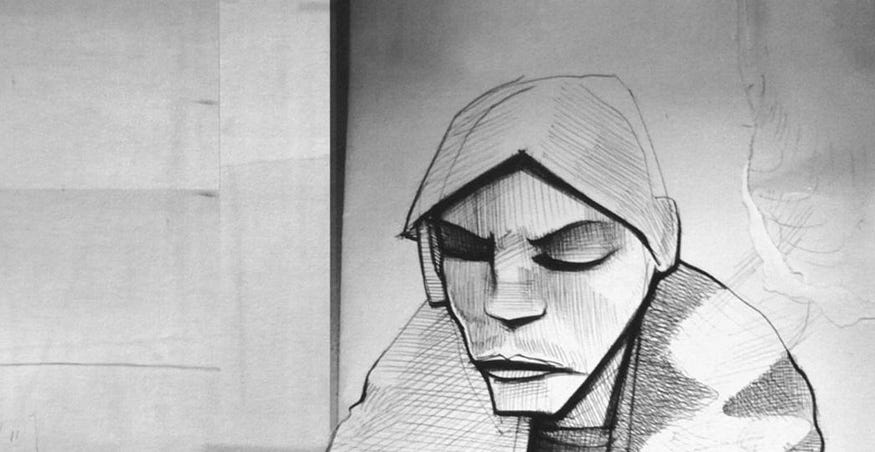
So yes, maybe after two articles on dubstep you are saying “damn dude you forgot Burial”. I will fix my mistake right now.
More seriously, I decided to talk about Burial specifically in the post-dubstep box, despite the fact that his first highly mediatised albums contributed to the popularisation of dubstep and are among the biggest successes of the Hyperdub label.
In fact, it took me a while to admit that Burial was making dubstep.
Because, sonically, we do not really find the wobbles, nor a very regular rhythm. On the other hand, from his first releases in 2005, William Bevan by his real name goes deeper than anyone in the sonic transcription of the dark, grey streets of the English capital.
He understood and integrated the original aesthetic of the genre.
However, he does not stop there, and in this Burial was probably the first DJ to draw inspiration from dubstep while mixing it with other styles (in his case ambient, trip hop, and UK garage).
Drawing inspiration here does not mean taking up all the sonic codes of a genre, but photographing its soul in a way. With his fractured beats reusing Metal Gear Solid sounds, his repitched, chopped voice samples, and dark drones fed on vinyl crackle and other artefacts, Burial’s music is unique, and offers a new universe, new possibilities for dubstep’s dark, urban aesthetic.
This ghostly side also fed journalists’ claims linking Burial with the hauntological current (a “genre” theorised around 2005 by the English trio of bloggers/journalists/academics Mark Fisher, Simon Reynolds, and Adam Harper; hauntology gathers musicians who use samples from another time resulting in tracks that are at once very current and filled with traces of the past).
This reverberated, distant side also comes from the fact that he approaches garage and jungle from a distance, never having been to a rave¹. (Hmm, talking about something you have never lived — that sounds like synthwave, all of this!)
“From the outset, Burial decided to avoid at all costs the rigid, mechanistic path that eventually brought drum and bass to a standstill. To this end, his percussion patterns are intuitively arranged on the screen rather than rigidly quantized, creating minute hesitations and slippages in the rhythm. His snares and hi-hats are covered in fuzz and phaser, like cobwebs on forgotten instruments, and the mix is rough and ready rather than endlessly polished. Perhaps most importantly, his basslines sound like nothing else on Earth. Distorted and heavy, yet also warm and earthy, they resemble the balmy gust of air that precedes an underground train ”²
DEREK WALMSLEY, The Wire
“This mix is a work of art in itself. I have to say I think it is the most wonderful mosaic of sound I have ever heard in my whole life — it does not even sound like it was made on this Earth, it could be a transmission from a star in a galaxy far far away… and I do not know about you, but this excites senses deep in my soul that I did not even know I had, and it makes me feel like I am falling in love with music at a completely different and way deeper level […] Burial, let the curtain fall, the stage is yours. Life and sound will never be the same again.”³
MARY ANNE HOBBS presenting Untrue to Radio 1 listeners in 2007
“ It is more about when you come back from being out somewhere; in a minicab or a night bus, or with someone, or walking home across London late at night, dreamlike, and you have still got the music kind of echoing in you, in your bloodstream, but with real life trying to get in the way. I want it to be like a little sanctuary. It is like that 24-hour stand selling tea on a rainy night, glowing in the dark. It is pretty simple. ”⁴
BURIAL, 2007
“ I wanna make tunes that are like a space in London but also a space in a club or in your head. A club is not that dissimilar to sitting on your own with headphones ”⁵
BURIAL, 2006
After his first EP South London Boroughs, Burial met success upon the release of his first album in 2006.
The Wire named it album of the year, and made it the first dubstep album (or at least one greatly inspired by it) to emerge from its own network. The following year, Untrue repeated the exercise.
This musical style so fresh, new, and hyped in England would develop under the name future garage.
Today numerous productions carry this label characterising very floating UK garage beats.
To finish on Burial, let us say that his work fits within a post-dubstep aesthetic.
However the expression designates no precise genre, but gathers the creations of a few original composers, like James Blake, SBTRKT, Mount Kimbie… a UK scene rather praised by the local press. After his two cult albums, Burial would also work with Four Tet and Massive Attack, two figures of English electronic music.
A genre inspired by urban environments
We will have seen throughout the evolution of original dubstep and notably with Burial that the genre particularly reflects its conditions of production, very urban. The atmosphere permitted by dubstep minimalism — between snippets of voice, samples and dissonant, repetitive, very cold sounds — evokes tarmac, concrete, London’s grey sky.
Elements imported from dub will particularly reappear as main, transcendent elements of a kind of anxiety, of urban monotony. The very pronounced use of delay, and above all sub-bass seeming to reproduce the continuous rumble of the city and transport that can be heard resonating inside buildings.
“ As English philosopher and producer Steve Goodman/Kode09 says, dubstep transforms the urban as much as it reflects it. He explains notably that it is music based on the “passive acoustic properties” of the city. The noise generated by what constitutes it is an integral part of the music. ”⁶
NICOLAS NOVA, 2011
For example, when large vehicles pass beside buildings in which you are present, the walls vibrate, and you hear only the low frequencies of engine noise.
Kode09 also released a book that looks brilliant on sound and its capacity to arouse negative emotions: “Sonic Warfare: Sound, Affect, and the Ecology of Fear” (available in French from Audimat éditions), one of the hinges in the development of sound studies in Anglo-Saxon universities in recent years.
How dubstep influenced music, notably EDM and Bass Music
Dubstep would massively influence EDM at the sonic level. Through the structure of drops (even if it shares this responsibility with trance, or garage).
The genre would also bring bass to become an element similar to vocal sonorities. Here, high-pitched sonorities like the human voice, which usually occupy the central role, are replaced by bass, which has a genuine melody.
Certainly this melody is less concentrated on “classical” musical notes than on the change of frequency of filters, very rhythmic.
Through this preponderant role of bass, dubstep, more than its elder siblings like dub, invents a new balance, a new relationship between instruments. This arrival of sub-bass that would gradually rise towards central frequencies at the end of the 2000s also dynamises dance music sound design like never before — creativity notably enabled by FM synthesizers and wavetable synths such as Native Instruments’ FM8 and Massive (we talk about this later).
Another major contribution: dubstep become brostep, as the first style characterised by a fashion phenomenon (which trap would succeed) within EDM, standardises the use of highly produced drum sounds. Big kicks and especially brostep snares would insinuate themselves into a large part of the EDM landscape, even in the most “chill” styles.
By adapting and evolving slightly, of course. Even the use of LFOs popularises — witness the explosion of future bass: the complex chords often heard in drops are modulated with LFOs, similarly to what can be heard with dubstep basses.
This fusion genre of the late 2010s is above all the child of trap and the melodic branch of dubstep.
Today brostep is part of the EDM sub-branch of bass music, which it in a way co-founded with drum’n’bass and UK garage at the end of the 2000s. Around 2013, trap music adds to the whole, which becomes a musical landscape allowing classification of new sub-genres arising from the fusion of the originals, as well as other genres gravitating around EDM.
Thus producer Jauz would create in 2014 what we can call wobble house, or bass house — a kind of house leaning of dubstep, EDM equivalent of the “bassline” genre, originating in Sheffield in England.
Numerous brostep producers soon embark, like Habstrakt, Datsik and Bais Haus under the name Ephwurd, Dodge under the name JVST SAY YES, and Joyryde, a genuine master of the genre, managing at once to innovate while reminding ears of speed garage groove through his sonorities and track structure.
JOYRYDE – HOT DRUM [Official Audio]
Outside bass house, despite being relatively narrow in its codes, a new generation of producers attempts from the second half of the 2010s a synthesis of all the influences that make bass music, and more besides. One of the great leaders of this movement is a leader: indeed, Canadian Rezz, spotted by Skrillex then signed to mau5trap, is the most in-vogue producer in her milieu, having succeeded in popularising midtempo bass: between bass sound design, techno rhythms and hypnotic minimal atmosphere. (If you have trouble grasping the genre, consider that the best tracks by Gesaffelstein at the beginning of the 2010s founded the genre).
REZZ x Deathpact – Life & Death
Behind her, appearing on certain tracks from her albums, enigmatic names like 1788-L, 13, Blanke, Deathpact, One True God (or even KAVARI for the experimental noise-leaning side).
At mau5trap or other independent labels like Synesthesia, numerous producers continue to trace the path of a bass music outside riddim that has not finished evolving, sometimes rediscovering disco or glitch sounds very inspired by Justice. Decidedly, the two Frenchmen are everywhere.
But of course, there are tons of other artists and different sub-genres inspired by dubstep and brostep.
Beyond electronic music
More generally, dubstep and its hyperactive little brother influence since the 2010s various musical projects, benefiting from the impact on the musical scene permitted by inclusion within the EDM umbrella.
First, on the rock side, beyond the already mentioned The Path of Totality by Korn, produced in 2011 with numerous brostep stars, Muse attempted dubstep with guitars on the last track of their 2nd Law album in 2012.
Muse – The 2nd Law: Unsustainable(Album released 28/09/12)
In a calmer register, English group Submotion Orchestra manages to integrate into its contemplative soul tracks, with jazz accents, dub delays and a minimalist structure leaving room for drum patterns and typical dubstep wobbles.
In short, the group still today shows proof that the dubstep vibe can be faithfully reproduced from acoustic or simply electric instruments.
Submotion Orchestra – Variations [Official Music Video]
On the wind instrument side, perhaps you have already heard the American trio Too Many Zooz.
Describing their style as “brass house”, the percussionist, trumpeter and especially baritone saxophonist make crowds dance in the New York subway as much as at festivals with a structure and rhythm inspired by house, and sometimes dubstep, when Leo P, the baritone, produces sonorities close to Skrillex’s best growls.
Too Many Zooz – House of the Glass Red, Pt I (Audio) | Fanimals
Still among wind instruments, trio Moon Hooch produces a kind of dance music that is at once punk and electronic.
Benefiting from perfect mastery of all avant-garde playing techniques, as well as rare adapted instruments, the two wind players, accompanied by their drummer, are capable of making rooms dance non-stop for a good two hours with their bass clarinets and saxophones.
YouTuber Andrew Huang made several sound design videos with Moon Hooch.
And then to return to the beginning of the 2010s, even if brostep never conquered the charts and still retained a certain audience, we cannot deny that its key characteristics placed it with the wind, in a recently past era where pop lived its maximalist moment.
Between hangover after the 2008 crisis and integration of electronic rhythms and synthesizers evoking dance music, American pop at the beginning of the 2010s is carefree, or at least wants to be more carefree than ever, fanciful and entertaining, placed under the sign of the party, infinite.
During this maximalist era, we can at least cite two sub-periods between 2009 and 2013.
And pop in all this?
Just after the period when American pop and its producers began turning to EDM-flavoured electronics (late 2000s), the period that followed was, with our contemporary gaze, more a parenthesis, a test, than a genuine trend.
Indeed, this period when pop tried to recuperate brostep proved rather unfruitful.
Between an aesthetic poorly suited to it, haphazard promotion, and sometimes a lack of sonic quality in productions resembling DIY, dubstep had a short passage among pop stars — short, but which at least has the merit of having existed.
At the production level, pop songs with dubstep alternate between already well-established pop producers and genre specialists invited to give a “cutting edge” colour on pop singers’ albums.
On the pop producer side, Rock Mafia, Cirkut, or others like hit machines Max Martin and Dr. Luke attempted to reproduce halftime rhythms and dubstep basses, more or less well crafted, essentially between 2009 and 2013. The title of first “dubstep” pop song goes to Freakshow by Britney Spears, on “Blackout” (2007), notably co-produced by Swedes Bloodshy & Avant (also creators of Toxic). On the dubstep musician side, Chase & Status came to produce two tracks on Rihanna’s 4th album, “Rated R”, in 2009; Rusko would have less luck — the four co-produced tracks for Britney Spears’ “Femme Fatale” (2011) would ultimately not be retained for the album.
Despite a few attempts, this very well formulated testimony from a Reddit user summarises the overall assessment we can draw: “ For roughly 6 months, the dubstep bridge replaced the rap bridge”⁷.
It must be said that it is particularly complicated to integrate dubstep into pop, for several reasons. The bridge — this somewhat brutal way of implementing a very characteristic sonic aesthetic supposed to be distant from pop — proves more fluid and effective with rap, which remains a showcase for the voice, whereas dubstep replaces the voice with synthetic basses, at the limit of changing tracks.
The ordeal continues afterwards in music video staging, where the nature and profusion of dubstep sounds bring them close to cinema sound effects: organic and evolving, the fact of almost hearing their movement in sonic space, coupled with their hyper-sophistication, breaks suspension of disbelief before an extradiegetic character too marked relative to the voice and “classical” instrumentation (we know it is playback, but we have no physical representation of the highlighted sound, as we can see an artist singing for example).
Thus dubstep bridges, in certain videos, are visually filled by relatively common choreography, in a shaky balance boosted by slow-motion or accelerated shots, and more frenzied, hallucinated editing (appreciate Pitbull, in the playlist below, who does not know where to put himself during the dubstep sequence).
However more globally, instrumental drops in tracks like “Where Have You Been” by Rihanna (2011), which take a more common EDM bassline, end up with the same problem for a few seconds anyway.
Fortunately, there are exceptions: integration went well in certain pop tracks — we can even give special mention to “Radioactive” by Imagine Dragons, which succeeds in marrying dubstep rhythm and sonorities with pop-rock with the success we know, renewing its somewhat nu-metal/emo vein à la Three Days Grace.
This compatibility between brostep and “emo” rock is ultimately not surprising, given the stylistic and sonic evolution of a Skrillex, at random.
Britney Spears – Freakshow (Audio)
Relationship between original “UK dubstep” and “brostep”: the “EDM” debate
Musicians and journalists pointed out quite early the very great diversity of sonorities grouped under the dubstep label, judged reductive.
This denomination problem crystallised especially from 2008, 2009, when the introspective codes of UK dubstep were “broken” in favour of a more open sound, without ceasing to employ the term dubstep.
The omnipresence of this new, more popular genre (some will say commercial) exasperated “purists”, who would henceforth sacralise the legendary origin of dubstep in Croydon, to resist what would be designated as bro-step.
“ For me, dubstep is very progressive, there are no rules. That was especially the case for the 12-inches that came out between 2006 and 2007. Even if you bought them all, they all sounded completely different. Even now there is so much being released and they are so diverse that you cannot tell who wrote a track when you hear it. And I think there are more and more people in Europe who are getting tired of it. The fans I really love, they are going back to the old school bass music. When I hear dubstep music made by artists who say to themselves, “Right, I am going to make a dubstep record,” I find it really boring. The people who built the scene, and are still making music in the same style are great, but the music made by their followers is super dull ”⁸
GOTH TRAD, 2012
This term I have pronounced a lot comes from a joke by DJ Kozee who talks about it on Twitter from late 2009.
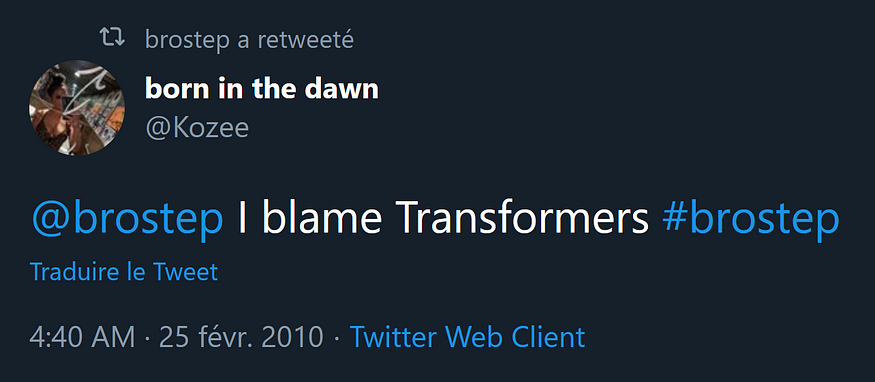
It ironically became the unofficial designation to talk about the Americanised fringe of dubstep, mixed with the word bro.
To summarise, the bro is the cliché of the boorish American student — in our case more consumer than genuinely “amateur” of music. (It is a pejorative prefix/suffix we find recently in criticism of “cryptobros”, amateur communities around cryptocurrency and NFTs).
This kind of “anti-American” reaction comes from the fact that brostep popularised mainly in the USA.
Thus, despite the fact that numerous English producers are pioneers of the genre, like Nero or Flux Pavilion, the gap is easier to dig between two concrete entities — England and the United States — rather than two musical genres using the same name.
But ultimately, is American popular culture not a synonym for globalised culture? We can effectively also see dubstep as a musical genre that passed from a local London subculture to a globalised, mainstream genre, “everywhere but nowhere”.
The self-declared conflict of purists against the rest seems almost always to have existed, but it would reach its apogee with the rise of EDM — triumphant entity of globalising globalised culture, which its detractors describe as an amorphous mush constituted of an infinity of local cultures. The very detailed history of Croydon dubstep has all the more effect of a legend as it contrasts with the lack of discourse on the origins of EDM-ised dubstep.
It has roots but far too many, which leads to seeing it as a uprooted musical genre.
This lack of concrete, physical anchoring in a place (or alternatively vague attachment to America, which amounts to the same), gives one more reason for the purist, underground branch to accuse brostep of being only a commercial product, while these groupings took care to write a history of UK dubstep, with the city of Croydon as its sanctified base.
The confusion linked to using the word “dubstep” for two different things also forms part of this fight, allowing fantasising of brostep movement members as uncultured, loud-mouthed thieves of authenticity.
“ EDM culture as a heterogeneous, culturally different entity functions precisely by utilizing those homogenizing strategies of nationalism — historicization, the origin myth, and other authenticity tropes. In recognizing the more complex nationalist strategies of repulsion, rather than attraction, a transnationalist vision of the culture allows us to preserve cultural difference as highly localized, without ignoring its homogeneous structuring within the global framework. […] The story of dubstep’s musical migration — from the sonic marker of south London’s suburban underground to a ubiquitous force in American mainstream media — represents a single case study in the increasingly dialectical terrain of EDM culture. ”⁹ MIKE D’ERRICO, 2015
The UK dubstep community therefore had for all these years the permanent feeling of “losing control” over something that “belonged” to them. This reversal happens notably at the “philosophical” level.
The culture around original dubstep — “meditate on the bass weight” — is based on something closed, interior, the complete opposite of the “vulgar” party represented by American bros developing in the 2010s with EDM festivals.
Brostep no doubt had all the more success because it was confused with dubstep, whose name immediately evoked an initially very integritous underground culture that cherished its own history. Perhaps even more important than philosophy: the sonic mutation towards brostep makes the gap particularly abyssal.
In purely musical terms: critique of the drop (brostep and EDM in general)
Indeed, concretely, beyond mockery of the fantasised brostep listener, certain “concrete” musical transformations made the “original” vibe disappear.
The main transformation is structural: whereas transitions between moments without and with bassline are noticeable for their minimalism in original dubstep, EDM-ised brostep is no exception to the drop rule.
The entire track concentrates on this kind of musical big bang that makes crowds dance. The English like as is their habit to attach to this distinction an authentic English crowd, and an American student crowd simply following the musical fashion.
Another victim of the great melting pot with other electronic genres: the purely instrumental side.
Indeed, the assault effected by the addition of surfed female voices worthy of the biggest hits by Fedde Le Grand or Benny Benassi on music concentrated on bass leads the genre to make concessions on its authentic elements.
Moreover, on the bass side, as we have seen, the obsession with wobbles and this element’s capacity to be developed leads the boldest producers to concentrate on it more and more from 2007, like Coki, Rusko, or Caspa.
“ You had the wobbling basslines. They were cool, but you have to be responsible with the wobble. When it got into a game of who could switch levels, and play louder and became a massive wobble fest, it totally lost the power of the original effect. ”¹⁰ Joe Nice, dubstep pioneer in the USA, 2012
“ Brostep is sort of my fault, but now I have started to hate it in a way […] I tried to put a bit more energy into it […] Now I think it has gone too far, it has got too noisy for noisy’s sake… ”¹¹ Rusko, BBC Radio 1, 2010
“ Dubstep went from being all about people listening to sounds to see who can sound the loudest. It has gone from being an inventive and organic style to being about who is badder and angrier ”¹⁰ Joe Nice, 2012
“ Dubstep was never meant to be that aggressive. Its root is dub, which is more peaceful, giving space to let songs breathe. Dubstep is meant to have bass, not all mid-range. It is too far gone in the other direction ”¹⁰ Joe Nice, 2012
“ It was the complete opposite of what was happening in drum & bass, which was all about sensory overload. ”¹² Drew Best, co-creator of SMOG, 2012
What is ironic is that dubstep, both among American pioneers of 2002 and later in 2007, was appreciated for being calmer than drum’n’bass, which had gradually been pushing all the sliders for 10 years.
This search for maximal sound tired the American underground public upon discovering dubstep.
It is therefore interesting to draw the parallel between dubstep whose minimalism was recognised until the end of the 2000s, and brostep which ultimately became the musical genre closest to the definition of maximalism.
If you follow a little on the web the community of producers or video makers who produce tutorials — because, for example, you are trying to work on Ableton or FL Studio — you quickly realise to what extent sonic level is one of the great obsessions on the list of things that make you say your music does not yet sound like Virtual Riot, with his overpowering growls.
Moreover over the course of his different tutorials, Virtual Riot ends up mocking the number of plugins and length of effect chains he uses, notably the almost mechanical use of OTT.
This multiband compressor became in a few years the golden calf of EDM producers. So much does its power and simplicity of use impose it everywhere, to the limits of abuse.
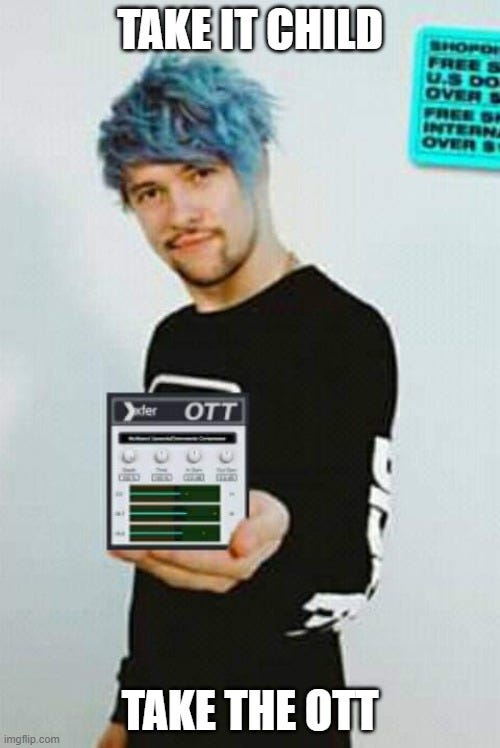
by “dubstepfrom2005”, on imgflip.com
Indeed, as a snub to the sharp critiques of the loudness war, EDM hardly concerns itself with nuances in music — on the contrary: it is dance music, and electronic to boot.
So the watchword, especially in dubstep, is “The sky is the limit”.
This kind of “OTT syndrome” is symbolic of the maximalist character of EDM, and in particular brostep.
References
¹ Fisher Mark, “Burial: Unedited Transcript”, The Wire, 12/12.
² Ibid. “Burial decided at the outset to avoid at all costs the rigid, mechanistic path that eventually brought drum ’n’ bass to a standstill. To this end, his percussion patterns are intuitively arranged on the screen rather than rigidly quantized, creating minute hesitations and slippages in the rhythm. His snares and hi-hats are covered in fuzz and phaser, like cobwebs on forgotten instruments, and the mix is rough and ready rather than endlessly polished. Perhaps most importantly, his basslines sound like nothing else on Earth. Distorted and heavy, yet also warm and earthy, they resemble the balmy gust of air that precedes an underground train”
³ Mary Anne Hobbs Show, 19/12/07. [from 0:51] “This mix is a work of art in itself. I have to say I think it is the most wonderful mosaic of sound I have ever heard in my whole life, it does not even sound like it was made on this Earth, it could be a transmission from a star in a galaxy far far away… and I do not know about you, but this excites senses deep in my soul that I did not even know I had, and it makes me feel like I am falling in love with music at a completely different and way deeper level… Burial let the curtain fall, the stage is yours. Life and sound will never be the same again…”
⁴ Hancox Dan, “‘Only five people know I make tunes’”, The Guardian, 26/10/07. “It is more about when you come back from being out somewhere; in a minicab or a night bus, or with someone, or walking home across London late at night, dreamlike, and you have still got the music kind of echoing in you, in your bloodstream, but with real life trying to get in the way. I want it to be like a little sanctuary. It is like that 24-hour stand selling tea on a rainy night, glowing in the dark. It is pretty simple.”
⁵ Clark Martin, “soundboy burial”, Blackdown, 21/03/06. “I wanna make tunes that are like a space in London but also a space in a club or in your head. A club is not that dissimilar to sitting on your own with headphones.”
⁶ Nova Nicolas, “The flip side of dubstep, when music tells the city”, OWNI, 21/03/11. [archive]
⁷ [Psirocking, “For like 6 months the dubstep bridge replaced the rap bridge”], commented in: ZombieBoy98, “The ElectroPop era was fun and exciting”, Reddit, 15/03/20.
⁸ E-Jima Naoki, “Goth-Trad: Inside the maze”, Resident Advisor, 12/01/12. “For me, dubstep is very progressive, there are no rules. That was especially the case for the 12-inches that came out between 2006 and 2007. Even if you bought them all, they all sounded completely different. Even now there is so much being released and they are so diverse that you cannot tell who wrote a track when you hear it. And I think there are more and more people in Europe who are getting tired of it. The fans I really love, they are going back to the old school bass music. When I hear dubstep music made by artists who say to themselves, “Right, I am going to make a dubstep record,” I find it really boring. The people who built the scene, and are still making music in the same style are great, but the music made by their followers is super dull.”
⁹ D’Errico Mike, “Electronic Dance Music in the Dubstep Era”, Oxford Handbooks, 01/15. “EDM culture as a heterogeneous, culturally different entity functions precisely by utilizing those homogenizing strategies of nationalism — historicization, the origin myth, and other authenticity tropes. In recognizing the more complex nationalist strategies of repulsion, rather than attraction, a transnationalist vision of the culture allows us to preserve cultural difference as highly localized, without ignoring its homogeneous structuring within the global framework. […] The story of dubstep’s musical migration — from the sonic marker of south London’s suburban underground to a ubiquitous force in American mainstream media — represents a single case study in the increasingly dialectical terrain of EDM culture”
¹⁰ Dowling Marcus K., “JOE NICE and the HISTORY OF DUBSTEP IN AMERICA, PART THREE”, The Couch Sessions, 18/01/12. “You had the wobbling basslines. They were cool, but you have to be responsible with the wobble. When it got into a game of who could switch levels, and play louder and became a massive wobble fest, it totally lost the power of the original effect.” // “Dubstep went from being all about people listening to sounds to see who can sound the loudest. It has gone from being an inventive and organic style to being about who is badder and angrier.” // “Dubstep was never meant to be that aggressive. It is root is dub, which is more peaceful, giving space to let songs breathe. Dubstep is meant to have bass, not all mid-range. It is too far gone in the other direction.”
¹¹ MistaJam, “The Story of Dubstep Episode 2”, BBC 1XTRA, 13/12/10. [fan YouTube excerpt] “Brostep is sort of my fault, but now I have started to hate it in a way […] I tried to put a bit more energy into it… […] Now I think it has gone too far, it has got too noisy for noisy’s sake…”
¹² Flatley Joseph L., “Beyond lies the wub: a history of dubstep”, The Verge, 28/08/12. “It was the complete opposite of what was happening in drum & bass, which was all about sensory overload”
4 – Dubstep and technology

In the previous part, we discovered the sonic characteristics of dubstep.
We also wondered how the maximalism that characterises it (in the same way as for EDM) contributed to forming the contours of 2010s pop music.
This search for sonic intensity, coupled with its synthetic nature, brings us to the subject of this fourth chapter, centred on the particular relationship dubstep maintains with technology.
If original English dubstep evoked the grim side of urban landscapes, brostep is particularly associated with technology in popular culture. Indeed, more than the highly produced, harmonious side of dance (which as its name indicates is above all associated with dance and partying), dubstep intrinsically evokes a brutal electronic sonic landscape: through wobble basses, glitch effects, and the noise-leaning, repetitive side associated with computer bugs.
Technology and its representation, cause of brostep’s transmedia role
What do we associate with brostep in visual popular culture? If you type the word into the YouTube search bar, you do not first land on well-known artists of the genre: you land on mixes, music compilations designed for parallel uses — first and foremost to accompany video game play.
Now, to accompany these compilations and attract clicks, the visual side is often not left to chance. These brostep compilations are designed with the “gamer” figure in mind.
Thus we find, in link with the maximalism of this music, all the “extreme” graphic codes common to both video games and Hollywood blockbusters — two cultural industries whose products are mostly designed for western white male youth.
On these comps, the gamer can admire in abundance martial violence, machines (cars or robots at choice) with a metallic aspect, or ultra-sexualised female figures.
On the artist side, the main representatives of this tendency are Borgore, criticised in 2014 for sexist lyrics, but above all Excision for his abundant, fluorescent visual universe.
Promotional image with Excision’s X. The codes of industry, metal, and hi-tech are pushed to the extreme.
The extreme character of brostep means the genre has since the beginning of the 2010s been directly integrated into video games, or in the case of films, into trailers.
During Skrillex’s explosion notably, the similarity between brostep, machine and robot sound effects, and hi-tech aesthetic generalised the use of evocative titles in numerous big-budget action films, often around themes of racing, violence, and apocalypse
“In fast-paced, neo-cyborg, and alien action thrillers like Transformers, Cowboys & Aliens, or G.I Joe, as in dystopian FPS games like Borderlands, Far Cry 3, and Black Ops 2, modulated oscillator wobbles and bass portamento drops consistently serve as sonic amplifiers of the male action hero at the edge. Assault rifle barrages are echoed by quick rhythmic bass and percussion chops, while the visceral contact of pistol whips and lobbed grenades marks ruptures in time and space as slow-motion frame rates mirror bass ‘drops’ in sonic texture and rhythmic pacing.
Hardness is the overriding affect here: compressed, gated kick and snare drum samples combine with coagulated, ‘overproduced’ basslines made up of multiple oscillators vibrating at broad frequency ranges, colonising the soundscape by filling every chasm of the frequency spectrum. The music — and the media forms with which it has become entwined — has served as the affective catalyst and effective backdrop for the emergence of an unabashedly assertive, physically domineering, and adrenaline-addicted ‘bro’ culture.”
Mike D’Errico¹, musicology and media studies researcher, 2014
This long passage expresses rather well the power released by brostep’s sonic elements, put in the service of post-cinematic commercial products. Researcher and feminist philosopher Robin James even succeeded in theorising the behaviour of the brostep symbol — wobble bass — as the sonic signature of neoliberalism.
Wobbles, filtered by an LFO (low frequency oscillator) modulated by a sine wave, create a feeling of contained power — that of pure electronic impulse, without artefact — all the more powerful when the LFO influences both mid and low frequencies, even sub-bass.
“ Sound, light, and electricity can all be modeled as sine waves, just as sine waves can be used to model the probabilistic risk-management algorithms favored by biopolitical neoliberalism. ” Robin James², philosophy and gender studies researcher, 2015
(…OK, I grant you, here we are venturing towards deep sound studies). In plain terms, brostep easily slipped into its costume as a transmedia musical element, encouraged by a noise-ism that fits into a relatively phenomenal evocative power.
By bros for bros
Obviously, not all dubstep producers are very enthusiastic about this apolitical neo-hardcore for digital natives. James Blake is moved, for example, by the way in which, according to him, brostep crystallises in music what he describes as a particularly unrestrained hyper-masculinity³, almost self-parodic, already visible in graphic supports such as “blockbuster”-type films since the 1980s, or certain testosterone-fuelled video games, mostly FPS.
These very masculine video games, focused on war or combat, are from their conception designed by a fringe of the population already influenced by the hyper-masculine side conveyed by American big spectacle industries.
Thus designers and programmers, as masters of virtual space — those same people who set up the universes in which players will evolve — transmit this quasi-deific creator power into the player’s hands, through what they control in the game: very often a human-looking, masculine, very muscular character, overpowered in their own universe. Think for example of Prince of Persia, God of War, Far Cry, or the GTA series in its absence of rules and total freedom of action.
Returning to music, the use of brostep in these films, series and games gives it what media studies researcher Henri Jenkins calls a “transmedia” role⁴, within the framework of a convergence culture that would characterise an entire fringe of contemporary western popular culture.
Steven Shaviro, another specialist on the question, speaks of a post-cinematic current, in the influence that trailers (“cinematics”) have on other media forms regarding energy and editing speed⁵.
Editing and accompanying music are here one tool among others to hyper-rhythm, to project energy as well as possible onto this potential audience (the trailer being by definition an advertisement).
Thus several media are compiled, and sometimes produced for a single purpose — here selling cinema tickets.
In blockbusters and FPS games, the idea is to offer the viewer or player an ever more captivating experience.
Official Reveal Trailer | Call of Duty: Black Ops 2
But if we talk here about machismo and the gamer figure, it is above all because content producers attempt to characterise “their” public, to target it, in clips accompanying the music, or in popular culture, particularly on the internet.
The vision of one’s own audience (on the internet)
Now beware: the beginning of the 2010s is the era of geek culture’s triumph, and thereby the resurgence of stereotypes of teenagers rejected by high school “jocks”.
That is how for a time dubstep alone symbolised the narrative of the exclusive geek coming out of his burrow and becoming cool. It must be said that the nerd image of the DJ/producer was embodied to perfection in the media by Skrillex — little guy with an emo haircut and thick-rimmed glasses.
He perfectly illustrates the paradox of the individual who seems shut in all day on his computer, but who in reality makes monster crowds dance while being at the centre of attention at night.

“At the edge of his metal staircase, Skrillex looks like a skater kid turned goth turned hacker” Neil Strauss, Rolling Stone, 01/03/2012
The “geek fantasy”: keeping one’s mysterious, dark, “different” image, while being king of the world at night, who dictates their own rules.
In other words, the geek fantasy conveyed in this period is this contrast between the young man who seems reserved, shy, fearful during the day, but who masters the codes of masculinity at night: “This guy looks weird, but actually it is thanks to him and his sounds that you pull at the club” (A double life very similar to that of comic book heroes).
However brostep is not the worst. Even if the coincidence between virility and brostep is understandable in the 2010/2013 period, when EDM-isation (the process of gathering numerous genres and electronic cultures under the EDM label) was brand new, the very image of these DJs is more emo/punk/nerd (generally) than “bro sport jock”, like Timmy Trumpet for example. At first bro culture indeed seemed to symbolise brostep.
But a posteriori, the visual universe of the genre is durably linked to technology, to the internet, more than big room house, for example.
Technology as tool
After talking about the representation of technology, let us now talk about technology as tool, since it is ultimately this very omnipresence of technology in the artistic production process that leads it to be constantly evoked in finished works.
Back to LFOs: these are used in dubstep to filter basses, making them evolve over time, and thereby giving them a certain rhythmic function.
“When this process is applied to multiple oscillators simultaneously — each operating at disparate levels of the frequency spectrum — the effect is akin to a spectral and spatial form of what Julian Henriques calls ‘sonic dominance’. Massive allows the user to record automations on the rhythm, tempo, and quantization level of the bass wobble, effectively turning the physical gestures initially required to create and modulate synthesizer sounds — such as knob-turning and fader-sliding — into digitally-inscribed algorithms.”⁶ Mike D’Errico, 2015
Beyond LFOs, the “full” and over-produced side of brostep and EDM music in general evokes a sonic maximalism unknown previously. If this aspect is so significant, it is explained by the production context of the musical works themselves.
DAWs, or digital audio workstations like FL Studio, Ableton Live, Reason, or Cubase have a playful side, almost like a video game, and unconsciously incite, in their interface, stacking and piling always more sounds and effects, in chains that are in principle infinite (provided you have adequate hardware, of course).
“Compared with the analog hardware that underpinned early house and techno, the digital software used by the vast majority of dance producers today has an inherent tendency towards maximalism. In an article for Loops, Matthew Ingram wrote about how digital audio workstations like Ableton Live and FL Studio encourage ‘interminable layering’ and how the graphic interface insidiously inculcates a view of music as ‘a giant sandwich of vertically arranged elements stacked upon one another.’
Meanwhile, the software’s scope for tweaking the parameters of any given sonic event opens up a potential ‘bad infinity’ abyss of fiddly fine-tuning. When digital software meshes with the minimalist aesthetic you get what Ingram calls ‘audio trickle’: a finicky focus on sound-design, intricate fluctuations in rhythm, and other minutiae that will be awfully familiar to anyone who has followed mnml or post-dubstep during the last decade.
But now that same digital technology is getting deployed to opposite purposes: rococo-florid riffs, eruptions of digitally-enhanced virtuosity, skyscraping solos, and other ‘maxutiae,’ all daubed from a palette of fluorescent primary colors. Audio trickle has given way to audio torrent — the frothing extravagance of fountain gardens in the Versailles style.”⁷
SIMON REYNOLDS, music journalist, 2011
We see here that if the global brostep scene was so dynamic and flourishing during its hour of glory, it is above all because its existence was permitted and conditioned by the accessibility of computing: more precisely audio software, and notably digital wavetable synthesizers.
“It is no longer a question of whether you can make music, because the software is distributed, it is accessible”⁸ MARTIN CLARK a.k.a. Blackdown, journalist and DJ, 2011
Indeed, consumer computing and its democratisation played a great role in the development of dubstep.
Skream and Benga say for example that they began producing on PlayStation, with Music2000 software, while Skrillex recounts having composed Scary Monsters in his squat with only a Mac, Ableton Live, and a left speaker⁹. For 20 years, software grouped under the designation “digital audio workstations” has popularised, become more accessible, and benefited from constant improvements linked to the rise in power of consumer processors.
The quintessence of the home studio now allows everything to be grouped in a single piece of software, to which one can add as many plugins and extensions as one wants. That is how an entire market of virtual instruments developed, notably in reproducing recognised analog instruments.
Wob knobs
Let us talk a little about synthesizers:
Native Instruments is a German company offering numerous music software products, and greatly contributed to the rise of brostep with two iconic synths.
First, in the reproduction category, FM7 then FM8 synths, as their name indicates, virtualise the Yamaha DX7 — a famous instrument for its way of producing sound: FM synthesis, which uses frequency modulation, is indeed as complex to master as it is powerful, allowing obtainment of many very different timbres.
Coupled with the quasi-infinite capacities of digital, FM synthesis offered in these new digital instruments now makes the power of the latter accessible to very many musicians.
Far from the tons of synthpop hits of the 80s fed on the DX7, FM synthesis revived at the end of the 2000s through bass music.
After the release of FM8 in 2006, 2007 saw the arrival of Massive, a subtractive synthesis synth using wavetables.
First, subtractive synthesis is simply the production of a wave, often very rich in harmonics, that one will filter to keep only a certain frequency range.
To produce these base sounds, before filtering, Massive uses wavetables — small audio files in which the software captures different small samples over time to make several sound waves, like basic sine or sawtooth waves.
NI Massive – Understanding Wavetables In NI Massive – How To Tutorial
The video shows how easy it is to evolve sound in Massive. (ADSR Music Production Tutorials, 2014)
Thus we have access not only to very many waves, but they can be evolutionary.
From the first to the last sequenced wave, wavetables provided by the publisher evolve progressively — flats or peaks form, allowing creation of very complex sounds very quickly, by evolving sound with LFOs or envelopes.
A kind of shortcut to avoid getting lost in the meanders of FM synthesis.
These pre-filter sounds can appear very strident in a mid register, almost more like noise than a note; however, as soon as one drops a few octaves on the virtual keyboard, a new world of bass opens to the musician.
Formerly strident harmonics transform into gurgles, growls, evolutionary. Evolutionary and repetitive, because not content with offering fixed filters, Massive obviously offers parameter automation on LFOs and envelopes — which Mike D’Errico talks about a little above.
- Right at brostep’s conception, its fetish instrument is released. Because yes, Massive would become a genuine phenomenon, especially from Skrillex’s success onwards, when numerous young internet musician hopefuls would want to reproduce the monster sounds of the young American and his colleagues.
In a way, this democratisation of computer-assisted music is more a massification in that it is responsible for a certain sonic homogenisation of brostep.
This parallel success with a sudden popularisation of music production software (MAO) made numerous heavyweights of music software jealous, releasing one by one their own wavetable synth.
That is when deadmau5 and Steve Duda’s small company Xfer Records intervenes — already known for having transformed a simple preset in Ableton into a certain multiband compression plugin named OTT, over-used in EDM. Xfer, therefore, releases Serum in 2013, which instantly becomes the spiritual successor of Native Instruments’ software.
Sometimes qualified as “Massive x1000”, Serum effectively approaches a boosted version of its big brother, allowing visualisation of wavetables, audio spectra, multiplying LFOs, envelopes, and controllable parameters, while bringing a genuine entire tab of effects designed for EDM in its most maximalist aspect.
And above all, Serum finally allows importing one’s own wavetables, this time allowing a genuine infinity of sonic possibilities, when everyone was beginning to exhaust Massive, worn to the extreme.
The passage between Massive and Serum, for that matter, highlights a certain sonic homogeneity of brostep — an attentive listener recognising the quasi-systematic use of phaser or flanger, as symptomatic of Serum and its interface inciting use of the numerous available effects that can be modulated by LFO or envelope (envelopes, nicknamed ADSR, are like fixed LFOs: it is for example what allows controlling the attack, duration and end of a sound when the envelope controls volume, like all synths.
ADSR envelope synth tutorial part A
Graphical representation of an envelope. (Synth School, 2010)
HOLY INTERNET
The democratisation of this software of course did not simply happen without the development of the web.
Because like everything linked to computing, the arrival of the internet and the web is a revolution on the same level as the arrival of microcomputers in households.
Now, not only can everyone produce music, but everyone can also distribute it, and contact other enthusiasts, within the very community aspect that appeared on the web from its birth.
Thus, without specialised forums flourishing during the 2000s like dubstepforum.com, without online record shops, without social networks and other media hosting sites like YouTube or SoundCloud, dubstep would clearly not be what it is today, and would have remained underground, living off a handful of labels, radio stations, and a relatively restricted community.
“Worldwide, the reason I think that it has gone so big, so quick, is because of the Internet. Without a doubt. The Internet was not around when drum and bass first launched. That took a lot longer to catch on, you know.”¹⁰ Hatcha, dubstep pioneer, in 2008
Skrillex’s career is often described as one of the first to have benefited almost exclusively from the internet.
Without advertising, just by posting his tracks on YouTube, Sonny Moore gathered a gigantic community of fans in the four corners of the world.
Google’s subsidiary allowed dubstep to flourish online, by freely making available an infinity of tracks, sometimes uploaded by “promotion” channels acting in a few years like labels: witness the examples of Monstercat, and above all UKF.
YouTube became for brostep a genuine medium hosting both musical content but also allowing the genre to impact the entire platform in media and artistic emulation (it is also on YouTube that several videos would appear showing “dubstep dance”, a kind of robotic hip-hop performed on fashionable brostep tracks at the beginning of the 2010s).
Media emulation, artistic — we said it — and even a fusion of the two: indeed YouTube is also a gold mine for memetics.
Practices like nightcore find themselves transposed at the beginning of the 2010s to dubstep music: numerous internet users now able to access the most powerful music software available remix with more or less boldness cartoon themes, video games — a phenomenon that would migrate again towards trap a few years later.
There are also many edits mixing film images with brostep, similar to AMVs (video clips made by Japanese anime fans to showcase both the music, but above all and especially the anime in question).
We witness here a culture developed entirely on the internet — new media space outside concrete reality, where there are almost as many contributing internet users as spectators of a cultural fact, through the omnipresence of sharing within web 2.0.
Hellsing Skrillex First Of The Year (Equinox) [AMV] Mix between the “Hellsing” anime and one of Skrillex’s hits, “First of the Year”. (mrtrafficstopper, 14/12/2012)
The internet contributed enormously to dubstep’s rise, and paradoxically, also caused it harm.
As we saw previously, the very “community” conception of certain platforms like YouTube and its comment section exacerbated the confrontation between purists and those who discovered dubstep by chance through brostep.
The separation between old-school dubstep and the much more popular one represented by Skrillex did not happen nominally.
It therefore translates into the invisibilisation of the first in favour of the second for the general public, and confirmation of the legitimacy of the resistance position adopted by representatives of “underground” sound¹¹.

Comment under one of Skream’s YouTube uploads of Rutten.
Moreover musical listening habits metamorphosed in a few years. Without talking about Spotify or Deezer, listening on YouTube became a habit for a whole generation that grew up with social networks and content hosting sites.
Thus, even if a classic dubstep track is available on the site, it is unlikely that the average internet user will bring out a big subwoofer, preferring to listen to their music as simply as possible with small speakers, headphones, or earphones, or with integrated computer or phone speakers.
The need to have adapted equipment to hear sub-bass properly, on pain of ending up before a kind of repetitive instrumental track of no interest crackling through small speakers, also participates in reinforcing a novice’s incomprehension before UK dubstep.
EDM continuum
Here we are at the end of this four-part feature on the history and influence of dubstep.
We went through the history of the genre in England; then its American/transnational development through brostep and riddim; its alternative branches, its influence on the rest of western music; and finally from its potential to evoke technology, through associated visual universes, and its very composition.
Simon Reynolds disserted a lot on the fact that in a musical object such as he theorises the hardcore continuum, sonic evolution happens very progressively between different DJs, labels, scenes: unlike musical genres like rock or rap, the musical mutations of the English hardcore continuum are not due to a few precise groups, are not great abrupt steps, but rather a relatively smooth slope.
Reynolds thus takes up the scenius concept elaborated by Brian Eno.
The very fact of talking about continuum calls into question the nominal and conceptual boundaries constructed between what we chronologically call rave, jungle, UK garage, drum’n’bass, 2-step, dubstep, and grime.
The journalist joins in this critique of categorisation numerous producers who are not comfortable with labelling their music navigating between several “genres”. Moreover, like any other musical universes, dubstep and brostep are categories created for practical purposes both for selling records to DJs and for the (general) public.
Now, these designations participate in a second phase in the codification of a genre: in numerous cases, giving a name to a genre de facto births it, gives it consistency, an existence.
From the outset, the term EDM was greatly criticised for its very fuzzy character — a kind of keyword allowing promoters and festival organisers to target precise audiences. For DJ DieselBoy, dubstep brings a much larger public to rave culture, and contributes to intensifying a business.
Indeed, EDM is sometimes seen as the industrialisation and massification of rave culture.
“The rave scene pulled back for a while, and eventually became rebranded as EDM. The word ‘rave’ has been replaced by ‘festival.’ Ecstasy is now called ‘Molly.’”¹² Dieselboy, American DJ
In the end, this word symbolising for some the commercial character of what it designates is in fact a good stimulant for the fusion of the numerous genres it gathers.
We can attempt here to analyse dubstep as a “gateway” genre, which both grew within the “hardcore continuum” theorised by Simon Reynolds, but which also greatly participated in the birth of a new continuum — that of EDM. In another dimension, we can also speak of dubstep as the first genuine musical genre developed on contemporary social digital platforms.
From SoundCloud, Discord and TikTok glitchcore, studied by Reynolds’ son¹³, to YouTube and forums that spread brostep, there is only one step.
References
— All links were verified on 18 September 2024 —
¹ D’Errico Mike, “Going Hard: Bassweight, Sonic Warfare, & the “Brostep” Aesthetic”, Sounding Out!, 23/01/14. “While Jenkins’ discussion focuses primarily on changes within the economic realms of film and television production that were occurring during the time of the book’s writing, one of the most dominant forms of convergence culture today exists at the intersection of EDM, action movies, and first-person shooter video games. The most prominent use of dubstep as a transmedial form comes from video game and movie trailers. From the fast-paced, neo-cyborg, and alien action thrillers such as Transformers (2007–present), Cowboys & Aliens (2011), and G.I. Joe (2012), to dystopian first-person shooter video games such as Borderlands (2012), Far Cry 3 (2012), and Call of Duty: Black Ops 2 (2012), modulated oscillator wobbles and bass portamento drops consistently serve as sonic amplifiers of the male action hero at the edge. Assault rifle barrages are echoed by quick rhythmic bass and percussion chops, while the visceral contact of pistol whips and lobbed grenades marks ruptures in time and space as slow-motion frame rates mirror bass ‘drops’ in sonic texture and rhythmic pacing. ‘Hardness’ is the overriding affect here; compressed, gated kick and snare drum samples combine with coagulated, ‘overproduced’ basslines made up of multiple oscillators vibrating at broad frequency ranges, colonising the soundscape by filling every chasm of the frequency spectrum. The music — and the media forms with which it has become entwined — has served as the affective catalyst and effective backdrop for the emergence of an unabashedly assertive, physically domineering, and adrenaline-addicted ‘bro’ culture.”
² D’Errico Mike, “Sonic Pleasure and Post-Cinematic Affect, by Robin James”, IASPM-US, 03/07/13.
“Sound, light, and electricity can all be modeled as sine waves, just as sine waves can be used to model the probabilistic risk-management algorithms favored by biopolitical neoliberalism”
³ Pelly Liz, “Interview: James Blake’s dub soft-shoe”, The Boston Phoenix, 28/09/11.
⁴ See: Jenkins Henri, Convergence Culture: Where Old and New Media Collide, trans. from English by C. Jaquet, Paris, A. Colin/Ina Éd., coll. Médiacultures, 2013 [2006], 336 pages.
⁵ D’Errico Mike, “Electronic Dance Music in the Dubstep Era” (section: Convergence Media and the Rise of the Sonic Meme), Oxford Handbooks Online, 09/15.
⁶ D’Errico Mike, “Electronic Dance Music in the Dubstep Era” (section: Notes on the Underground), Oxford Handbooks Online, 09/15.
“When this process is applied to multiple oscillators simultaneously — each operating at disparate levels of the frequency spectrum — the effect is akin to a spectral and spatial form of what Julian Henriques calls “sonic dominance.” Massive allows the user to record “automations” on the rhythm, tempo, and quantization level of the bass wobble, effectively turning the physical gestures initially required to create and modulate synthesizer sounds — such as knob-turning and fader-sliding — into digitally-inscribed algorithms.”
⁷ Reynolds Simon, “Maximal Nation”, Pitchfork, 06/12/11.
“Compared with the analog hardware that underpinned early house and techno, the digital software used by the vast majority of dance producers today has an inherent tendency towards maximalism. In an article for Loops, Matthew Ingram […] wrote about how digital audio workstations like Ableton Live and FL Studio encourage ‘interminable layering’ and how the graphic interface insidiously inculcates a view of music as ‘a giant sandwich of vertically arranged elements stacked upon one another.’ Meanwhile, the software’s scope for tweaking the parameters of any given sonic event opens up a potential ‘bad infinity’ abyss of fiddly fine-tuning. When digital software meshes with the minimalist aesthetic you get what Ingram calls ‘audio trickle’: a finicky focus on sound-design, intricate fluctuations in rhythm, and other minutiae that will be awfully familiar to anyone who has followed mnml or post-dubstep during the last decade. But now that same digital technology is getting deployed to opposite purposes: rococo-florid riffs, eruptions of digitally-enhanced virtuosity, skyscraping solos, and other ‘maxutiae,’ all daubed from a palette of fluorescent primary colors. Audio trickle has given way to audio torrent — the frothing extravagance of fountain gardens in the Versailles style.”
⁸ Flatley Joseph L., “Beyond lies the wub”, The Verge, 28/08/12.
“It is no longer a question of whether you can make music, because the software is distributed, it is accessible.”
⁹ Future Music, “Interview: Skrillex talks production, plug-ins and power edits”, Music Radar, 25/05/12.
¹⁰ Darkside, “Hatcha Interview”, Get Darker, 23/07/08.
“Worldwide, the reason I think that it has gone so big, so quick, is because of the Internet. Without a doubt. The Internet was not around when drum and bass first launched. That took a lot longer to catch on, you know.”
¹¹ Strohecker David Paul, Dwan Ibalu, “The Popularization of Dubstep: FULL ESSAY (Parts 1 and 2)”, The Society Pages (Cyborgology sub-blog), 21/01/12.
¹² Flatley Joseph L., “Beyond lies the wub”, The Verge, 28/08/12.
“The rave scene pulled back for a while, and eventually became rebranded as EDM. The word ‘rave’ has been replaced by ‘festival.’ Ecstasy is now called ‘Molly.’ Instead of the hacked together grassroots appeal of Hyperreal, there are slick concerns like Dancing Astronaut.”
¹³ Press-Reynolds Kieran, “Deep-internet bubbles: How microgenres are taking over SoundCloud”, No Bells, 25/01/22.