Interview Skream
We interviewed Skream on the occasion of his visit to Paris for the first Basement Ltd night in February 2007. Long left on the to-do list, the interview is only published now, but most of what he said remains relevant.
We interviewed Skream on the occasion of his visit to Paris for the first Basement Ltd night in February 2007. Long left on the to-do list, the interview is only published now, but most of what he said remains relevant. Skream's imminent return to Paris encouraged us to put this exchange online, in which he describes the scene's slow evolution up to its current success as well as his upcoming projects.
Dubstep.fr: Tell us how things started… How did you see the scene evolve from FWD, then DMZ, etc.?
Skream: I'll talk about FWD, the well-known dubstep night in London. It started as an underground garage night and it was just for people who played not promos and already released tracks, but their own unreleased dubplate tracks.
Well, we were not really playing CDs back then, mostly dubplates. FWD was a place for people who played and appreciated underground music and originally it was really a UK garage thing: sharp dress, champagne in hand, well shod…
Then UK garage died, but FWD continued and the night moved from Velvet Rooms to Plastic People which is, as everyone knows, a very good London club. When the name shifted from UK garage to dubstep, it was only a journalist and specialist thing — you had a few DJs and producers and that was it.
To be honest they were not necessarily the most successful parties, but you heard the best underground music of the moment there. And it was as if everyone was involved in one way or another, but everyone put in much more effort than necessary because in 2003 overall vinyl sales collapsed, when 8-bar grime arrived in London it was, woah, it just killed vinyl sales. There were no record sales so at that time people did not really want to get involved because there was not much money, and when there is not much money who really wants to be involved as a DJ or producer?
So there were only a few people. Honestly the only people I remember, besides myself, are Kode9, Horsepower, Benga of course, Hatcha and Slaughter Mob, and it stayed like that for two years and it was a bit quiet, but I still wanted to make music and stay focused on it as much as possible. Benga was doing hip hop and Hatcha was booked for house and garage sets.
Then Digital Mystikz arrived and it was as if, at that moment, we had something fresh again, because all the pioneers who had made not dubstep but underground garage like El-B, Zed Bias, Artwork — like everyone they had given up.
El-B started doing hip hop, Zed Bias was still doing a kind of breaks, Artwork still does house, which he does well, so that is understandable, but it was as if it was already doomed to stay in the shadows before it even started, and then Digital Mystikz arrived, they just came with good tracks and it started getting interesting again, it started evolving again. Everyone… Benga got back into it and Hatcha got back into it like before and I started focusing on it more than I had before and everything started moving again. And London nights and dubstep are what they are now… The only thing I can say, for me having been involved from 2002 until now, is that London nights feel surreal because between standing in a club with twenty people and being in a club with 800–900 people, you think "Fuck!" — actually you cannot say anything, you are speechless…
Dubstep.fr: I think DMZ's first anniversary in March 2006 marked a turning point…
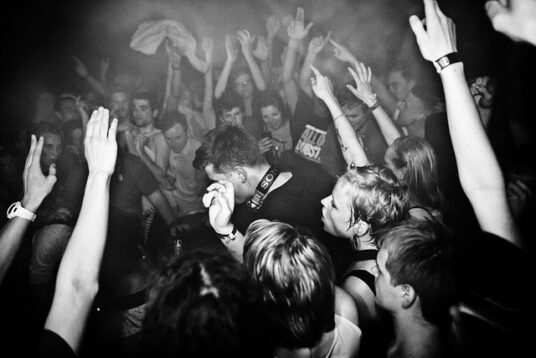
Skream: It was incredible! I arrived early, dropped off my record bag and all I remember is that around 11 pm I was at Third Base and everyone was losing it, we were all packed in like sardines. And I remember Mala (Digital Mystikz, organiser of DMZ nights. Ed.) telling me "We are moving the night to the bigger room upstairs." I thought it was a joke; I remember it was during Joe Nice's set and on the net there is a photo of Mala whispering to someone with a smile, and that summed up the night. I remember running around saying "We moved up, we moved up to the other room." And there were still hundreds of people downstairs and we went up… It was really a memorable night.
Same with the FWD night. There was my album launch party in October 2006 and it was the first time I saw FWD completely packed wall to wall. People coming in one by one: one out, one in, from eleven to midnight. And Sarah, who runs FWD and Ammunition, said to me: "Come here a minute." And I thought: "What have I done? Am I in trouble…" And she took me outside and showed me a queue of another hundred people. It was just before I was due to play and it put me under huge pressure. But now London nights are really very good to the point that Plastic People is full every Friday. DMZ is full whatever the date, same abroad, in New York and even in Australia where I played for the first time and they were really very encouraging. Everywhere, outside London, even in Bristol it is really very good, it is like a second home for dubstep, and you have Leeds which always puts on good nights, it is going really well everywhere.
Dubstep.fr: The first time I went to DMZ in 2005 it was still an almost family-like scene. Do you think current success has made you lose some of that particular atmosphere?
Skream: In fact, we all come from groups of friends. For example, there was me, Benga and Hatcha and we were all friends, then there was Mala, Coki, Loefah and Pokes, they were all good friends and when we met in 2004/05 we became very good friends, I am very close to Mala, I am close to most of them.
And I understand what you mean about the vibe at early DMZ because it was people who wanted dubstep to be… — in fact, not dubstep, I do not want to say dubstep — ; we wanted the music we were making at that time to be something special and everyone came there, even if they had something to do, if they had to go to a wedding or a funeral, well they went, and then they came to DMZ. So everyone wanted it to be special, because even if for me and others it was not our night, it was still where our music was played, where we played, where we wanted to do something different, so it was that complete unity.
It was everyone who was already in the know, who went out. It was: "Right, this is what we want, so we go and we help." Not help in the sense that it would happen anyway, but just, this is what we want. And now it is still that vibe. But it is like any scene in general, it starts with people who invest in it and now you have outsiders, they are not the original crew, but you need them and now they are there and you still have that unity between everyone.
But now everyone is used to the vibe of other people at the night. If you see someone a bit drunk, a bit loud, you just move, we are back in the real world, we are no longer in the dubstep world because now these are not specialist-only nights anymore. For example, at the second anniversary DMZ night, there was a crazy number of people from all over Europe, America, Australia, so now you have to deal with how others see the music.
For example, it has happened to me while mixing to hear people walk past saying: "I do not like this shit!" It does not really bother me because I know the majority of the crowd likes it. But it is good to hear someone say they do not like something, you take note, it does not mean you completely change direction, but it is good to hear other people's point of view.
I can see the vibe has changed, but I do not think it is for the worse. It simply means we have reached nights on the same level as other genres like house, drum & bass, hip hop. We now have the same amount of audience, whereas before there were only specialists. Now word of mouth and journalists have taken over. It is something you have to get used to in life, I think, like with any style of music.
Dubstep.fr: Tell us about your upcoming projects for the next few months. You are planning to launch your label, are you not?
Skream: The label is not completely finalised yet, but it is something I am going to do. It is about tracks I really like but that might leave Tempa or other labels indifferent.
It is a chance to release stuff I really enjoy and I want to bring back that old garage vibe where you had the original track and a remix on the B-side. That is how it was. You had the original and the remix on the other side, you did not have to wait three months for the remix. I just want it to come out.
And I want to put out new producers — that is what I really want to do. I know people like Kromestar, they are already established, but I want to help them even more; and Quest, Silkie, people like that: they are very good producers, but they are not exposed enough. I also have a couple of other producers, like my brother Hijak and a friend named Snake… There are a few people I want to bring to the scene because they deserve it. These are people who have never truly been noticed, so I want to draw attention to them.
Dubstep.fr: I heard about a few remixes for other scenes, techno among others…
Skream: I did a remix for Mark Ashken, a minimal techno producer from Leeds, UK. He had heard techno artist Craig Richards play some of my tracks and contacted me and asked for remixes. I am happy because it opened another facet of music from what I usually make, like driving minimal… The tracks are called "Roots Dies Dark" and "Side Spree".
I think they should come out at the end of March 2007, on Leftroom, at the same time as Skreamism 3. There are also two remixes I am happy with. I did this remix for a guy called Dr Blue, for an English dub producer, he did a track called Dr Who and I just did a remix and I am quite satisfied with it. I did remixes for Benga. And I think with Mala we will soon exchange tracks to remix.
Hopefully I will work a bit more with Coki and Loefah. I really want to work again with Loefah because we work very well together. I will do more things with my brother Hijak. I just want to keep going in the same direction.
I might also go to the States to do production. I do not really know for whom (laughs), but apparently it is planned… That is great because for me it is always about learning, in the end. I am twenty years old, and everything I have not been able to do yet is because I am only twenty. I want to reach twenty-five and be an established artist.
Dubstep.fr: Thank you very much Skream. Would you like to add anything?
Skream: Yes thanks. Go out and buy Skreamism 3 please and if there is a new album at the end of the year please go buy it.
Words collected by Alex King and Synaptic, transcribed by Poppy and translated by David. © Dubstep.fr 2008. All rights reserved.